
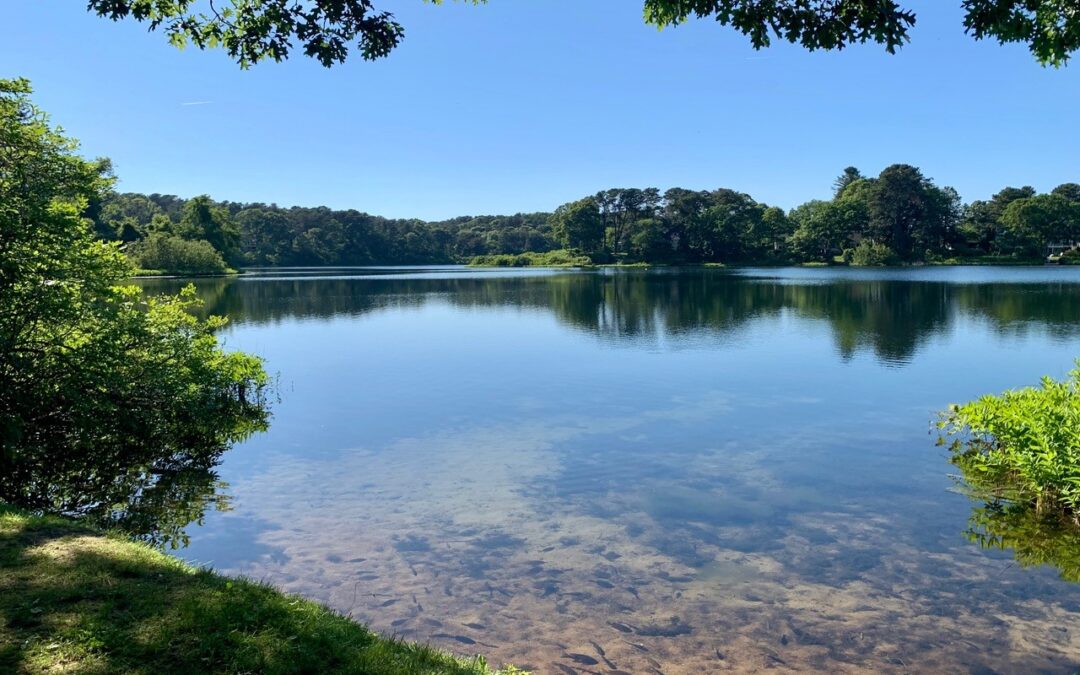
Above: Lovers Lake, Chatham. Photo by Sue Machie
Cyanobacteria have been in the news a lot lately. While APCC provides information about cyanobacteria on our website, we recognize that the information can be dense and complicated. To demystify the subject, we are launching a series of bite-sized cyanobacteria informational emails to help you understand what may or may not be happening in our ponds. Our goal is to help educate you, so you can make informed decisions when choosing to recreate in our ponds and lakes.
The Basics
Cyanobacteria are microscopic organisms found in Cape Cod’s freshwater ponds. They have existed for billions of years and were among Earth’s first oxygen producers—we quite literally wouldn’t be here without them. Cyanobacteria are present in healthy ecosystems, but under certain environmental conditions cyanobacteria can multiply rapidly and form what is known as a bloom.
Some types of cyanobacteria can produce compounds called cyanotoxins. There are many different species of cyanobacteria and many different cyanotoxins. During blooms, there is an increased possibility that toxins will be present.
Toxins can be produced whether there are relatively few or many cyanobacteria present. However, in general, higher concentrations of cyanobacteria increase the likelihood that toxin levels will be more widespread. And when toxin-producing species are present in higher-than-normal numbers, toxin levels can be higher.
Stay Informed
APCC manages an extensive monitoring program that seeks to identify blooms, as well as the conditions that may lead to imminent blooms. The results of our monitoring are published on an online map that the public is encouraged to use as an informational resource. The issuance of a public health advisory is the job of town health agents, and while our map reflects formal advisories issued by a town, the map also identifies situations where APCC feels there is the potential for concern that has not yet warranted the issuance of a public health advisory.
Most Cape towns understand the intent of our map and support it through contractual agreements with APCC to undertake cyanobacteria monitoring on their behalf. Three towns (Brewster, Orleans, and Dennis) do not contract with APCC, yet ponds in these towns are monitored by volunteers associated with our program, and the data is reflected on our map. Some of these towns maintain their own websites depicting the status of their ponds and this may differ from the results shown on APCC’s map because they do not utilize our “Potential for Concern” status.
It is up to you what weight you want to assign to the town sites versus APCC’s cyanobacteria map. We want you to know that whenever a public health advisory is issued by a town and they tell us, it will be reflected on APCC’s map.
“““““““““
Coming next in the series: What to look for and how to protect yourself and your pets from possible exposure.