Association to Preserve Cape Cod |
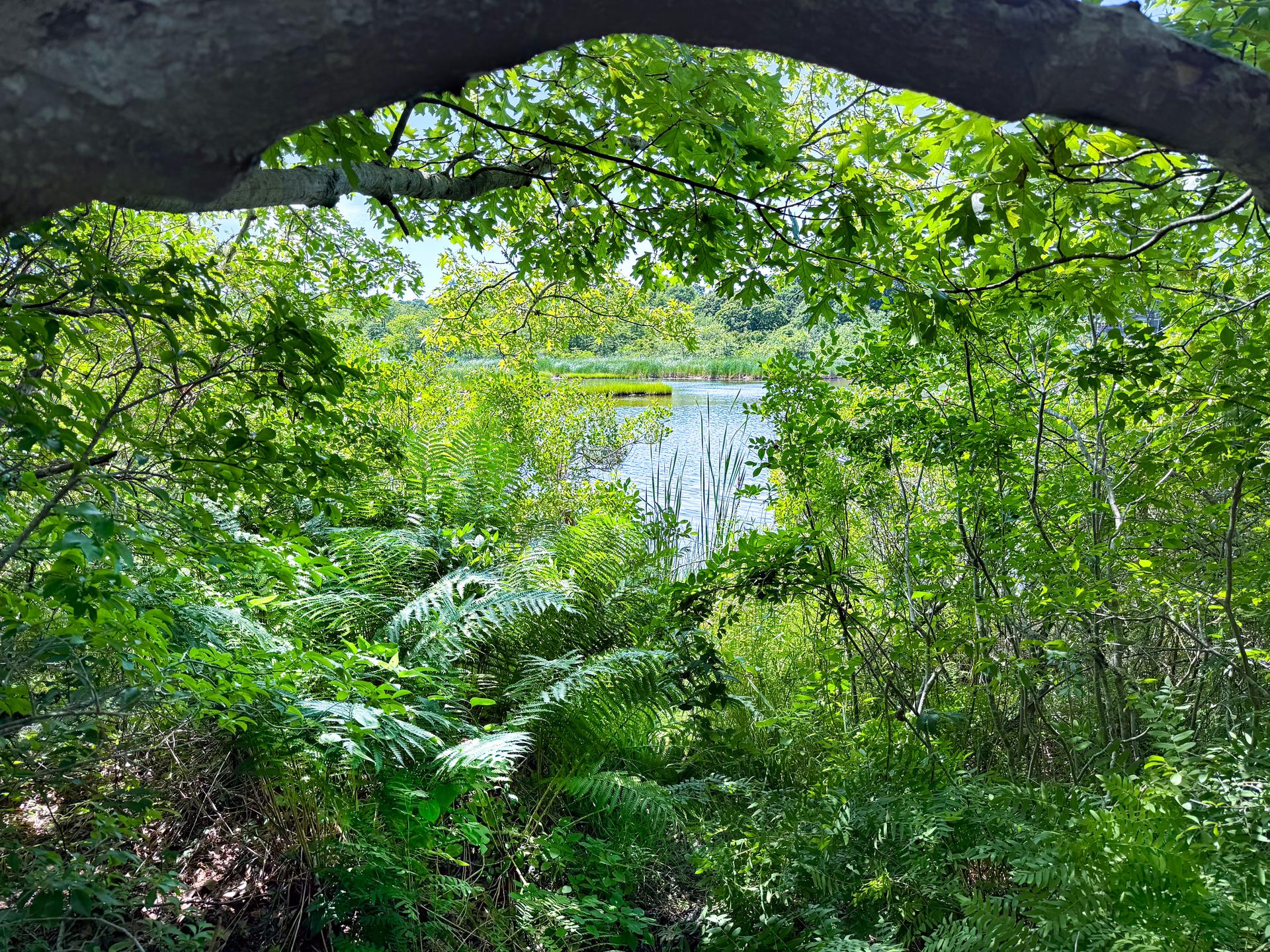
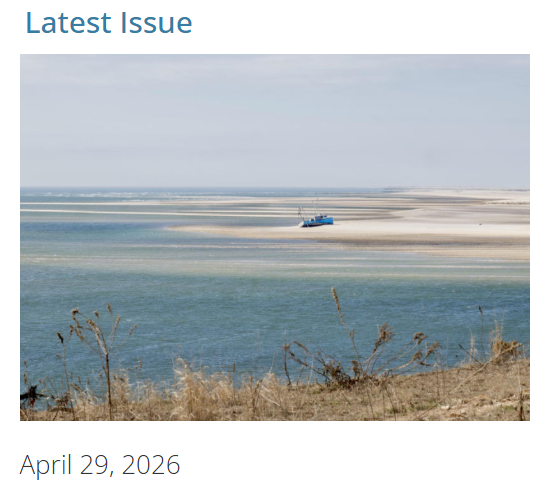
Above: Frost Fish Creek, Chatham. Photo by Sue Machie. |
|
|
|
| The Report Is In
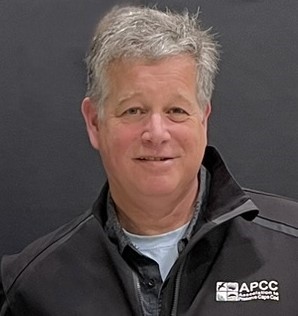
by Andrew Gottlieb, Executive Director |
APCC’s Annual Report will be arriving in your mail in the coming days. The report documents the substantial work undertaken by APCC’s staff in concert with our volunteers and benefactors to protect, restore and defend the Cape’s fragile environment. The timing, as a capstone to the summer season, is intentional: No time seems better to highlight our impact on the environment than during the peak of most people’s use and enjoyment of the land and water.
|
|
|
|
Our message is as simple as it is direct: APCC’s tireless efforts to protect the Cape yield results. I take pride in the fact that although small we are mighty and have an impact the envy of larger organizations. While the report provides encouraging documentation of the difference we are making, the subtext is that much remains to be done and that the headwinds are strong.
It is in that last context that our Annual Report serves as a reminder of the importance of your support. Hard fought gains can be lost if resource limitations constrain our ability to remain diligent. APCC succeeds because we have talented and committed environmental professionals that member support allows us to attract and retain. When your copy arrives in the mail, it will include a reminder to support our work at the end of our Summer Appeal. Or you can help us right now by clicking here:
|
While we are at it, I encourage you to join us at the APCC Annual Meeting at noon on Sunday, September 20, 2026 at the Dennis Inn. |
|
|
|
|
APCC Annual Meeting
Sunday, September 20th 12:00 - 2:00 p.m. The Dennis Inn "under the tent" | |
|
|
Ecosystem Restoration Program |
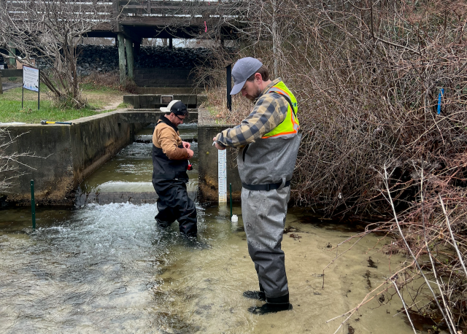
Above: Project partners collect water-level measurements at the Mashpee River fishway as part of ongoing monitoring and restoration planning. |
APCC and Partners Awarded Funding for Next Phase of Restoration Projects |
APCC and its municipal and project partners have been awarded more than $445,000 in state funding to advance restoration projects in Mashpee, Dennis, and Yarmouth. The awards are part of more than $45 million awarded by the Healey-Driscoll Administration to 97 projects statewide through the new Environment and Climate (ECO) One Stop program, which supports projects that strengthen infrastructure, restore and enhance natural resources, improve public safety, and increase resilience to flooding and other climate impacts. These Cape Cod awards will support the next phases of design, permitting, engineering, and implementation for river and wetland restoration and stormwater improvement projects.
The town of Mashpee has been awarded $250,000 through the Dam and Seawall Grant Program to advance permitting and design for the Mashpee River Fishway Dam Removal and Replacement Project, with engineering support from Tighe & Bond. The project will remove the existing fishway dam and replace it with a more natural, free-flowing river channel and improved road crossing. This funding complements ongoing work in the upper river supported by the USDA Natural Resources Conservation Service and Cape Cod Conservation District, as well as a NOAA grant awarded to APCC for community engagement, monitoring, and restoration planning in the middle and lower river.
The town of Dennis has been awarded $140,854 through the Coastal Zone Management (CZM) Coastal Habitat and Water Quality Grant Program to support data collection, modeling, and structural analysis for the eventual replacement of the Loring Avenue Bridge. Since 2022, APCC has worked with the town and partners to advance restoration of Weir Creek. Evaluating the Loring Avenue crossing is the next step in this broader watershed-scale effort to improve tidal exchange, connectivity, community resilience, and coastal habitat.
The town of Yarmouth has been awarded $54,482 through the CZM Coastal Habitat and Water Quality Grant Program to advance priority stormwater remediation projects at Wings Grove Beach on Long Pond and along Old Main Street. Since 2022, APCC, the town, and Horsley Witten Group have worked together to identify priority sites and design and install improved stormwater systems. This next phase will further reduce polluted runoff, improve habitat for shellfish, diadromous fish, and other wildlife, and help protect local waters for recreation.
Together, these awards build on years of collaboration among Cape Cod towns, APCC, state and federal agencies, and technical partners to improve habitat, water quality, climate resilience, and public infrastructure to support the environment, the economy, and our local communities.
|
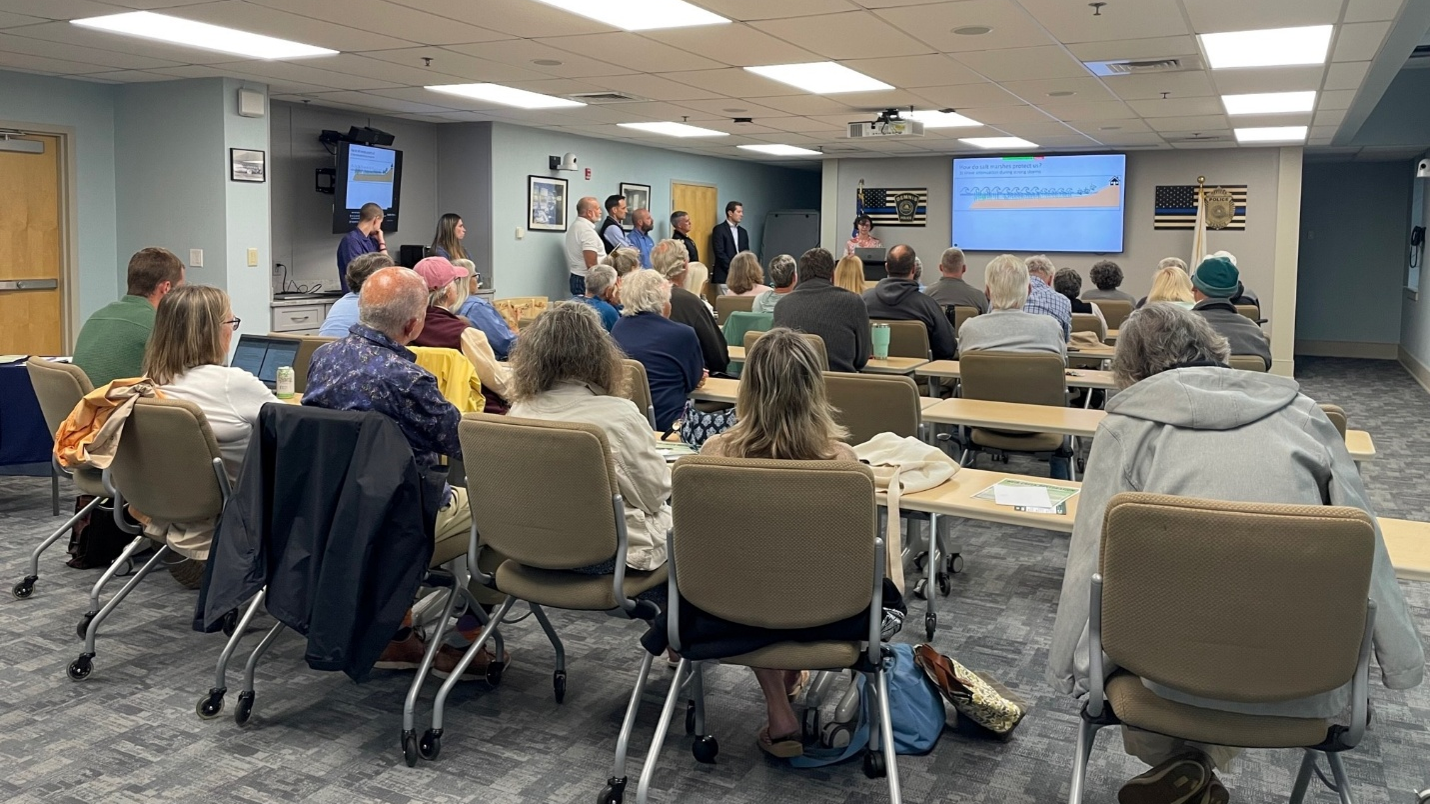
Above: Weir Creek salt marsh restoration August 2025 public meeting. |
|
|
|
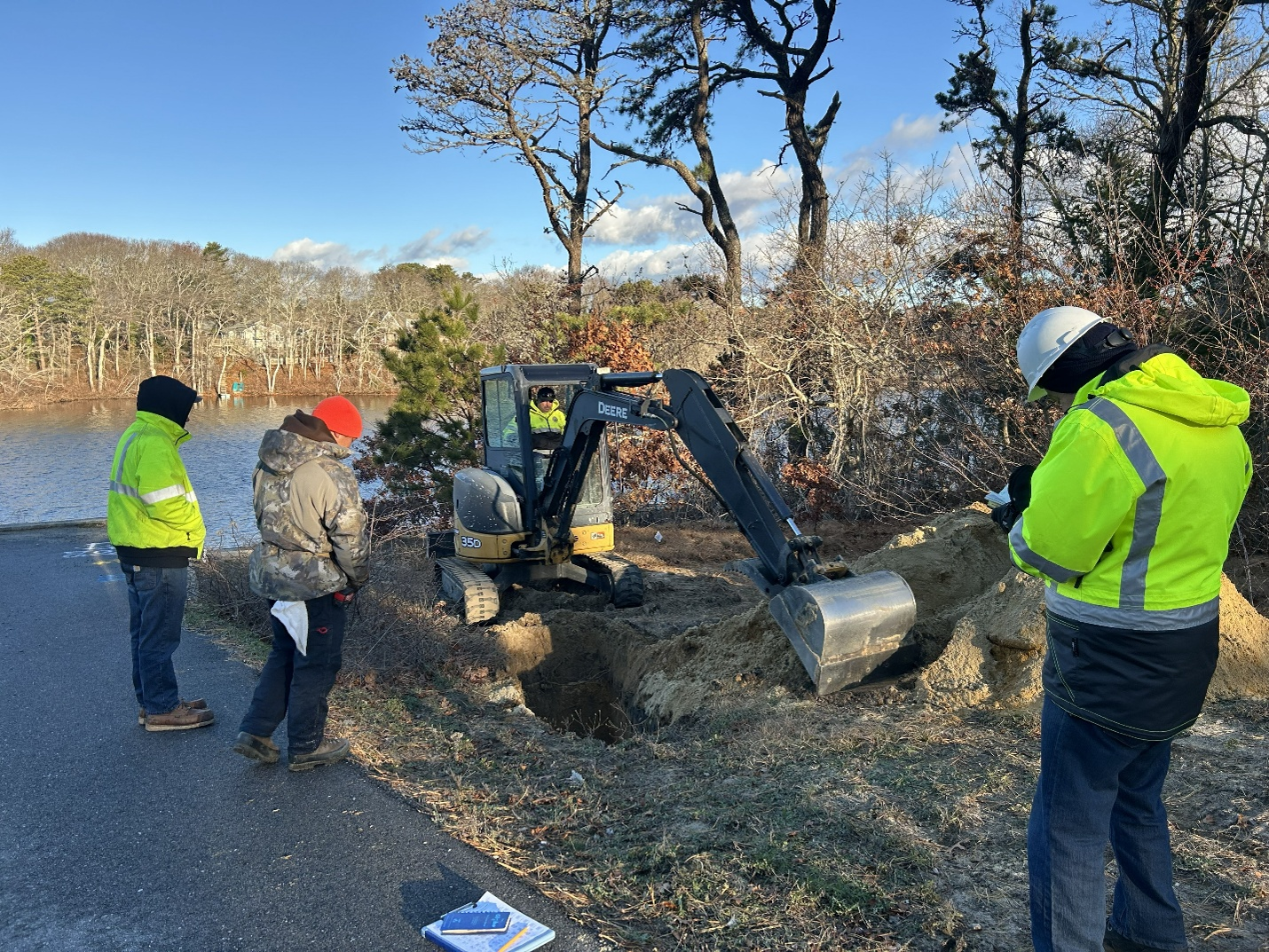
Above: Wings Grove Beach, Yarmouth test pits for assessment of sites for new green stormwater installations. |
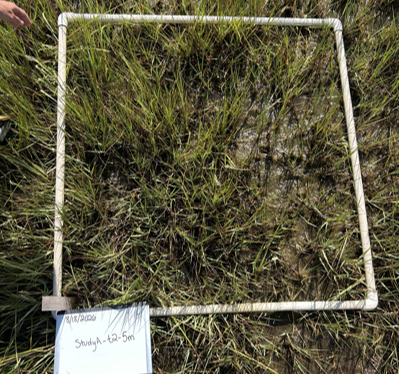
Above: Example of a vegetation monitoring plot in the salt marsh upstream of the western Lower County Road culvert. |
Summer Fieldwork Continues at Weir Creek Salt Marsh
The Ecosystem Restoration Program recently completed vegetation monitoring at Weir Creek in West Dennis, MA, returning to pre-established plots at several long-term monitoring locations in the marsh. Vegetation was first monitored at these locations in 2024 with support from the Cape Cod Conservation District, providing baseline measurements of vegetation communities in Weir Creek. Monitoring was conducted again in 2026 with support from a Salt Marsh Restoration and Monitoring grant from the Massachusetts Department of Environmental Protection, coinciding with recent sediment and hydrological monitoring at Weir Creek.
Vegetation monitoring provides critical information about salt marsh condition and change. At each monitoring plot, a 1-meter by 1-meter quadrat made of PVC pipe is laid down on the marsh to define the area where observations will be made. Staff record the individual plant species within the plot and estimate their percent cover, along with the amount of bare ground and dead plant material. Together with the data collected in 2024, this new dataset will provide valuable information about salt marsh conditions before drainage enhancements and culvert replacement. Following restoration, these pre-restoration data will help APCC and partners measure success and guide adaptive management actions.
This past week was also the last of the season for our 2026 Restoration Intern Ryan Weinsier. The ERP team thanks Ryan for her hard work and dedication to APCC’s mission. We wish you the best, Ryan! |
|
|
|
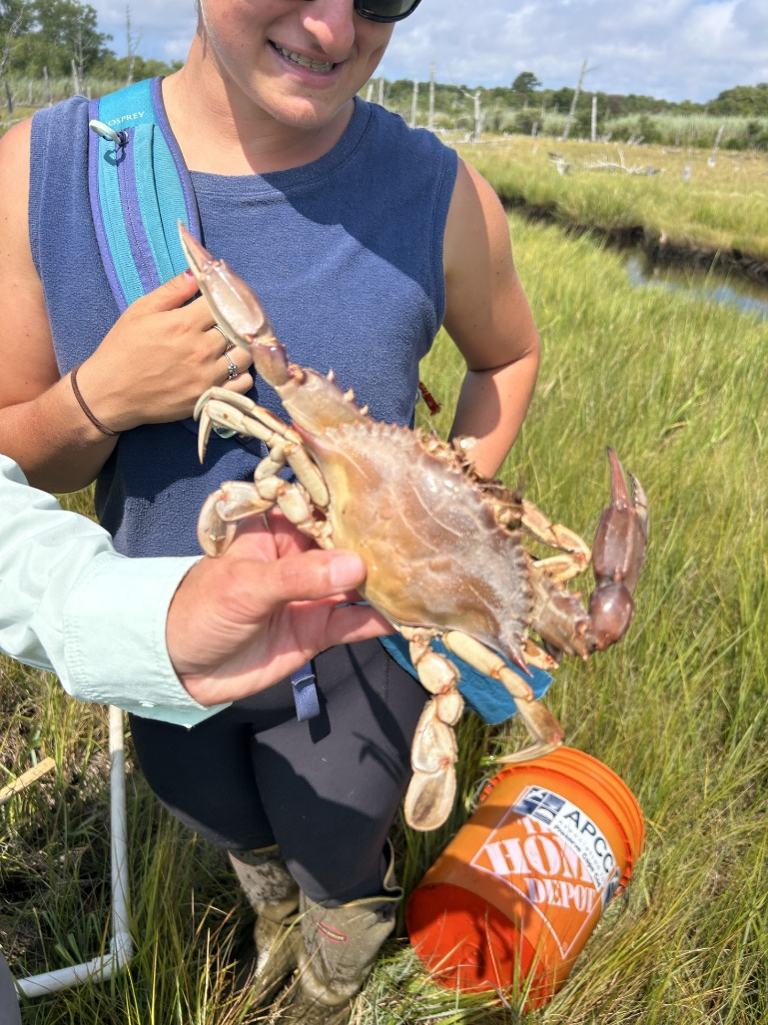
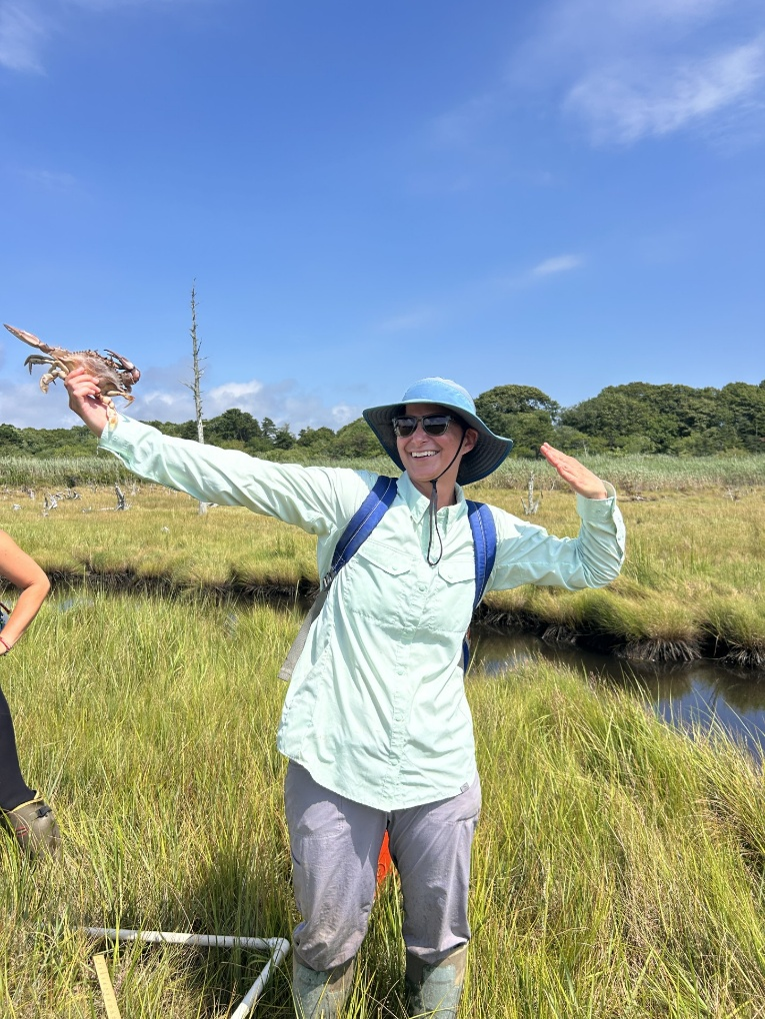
Above: Ryan Weinsier (left) and Jordan Mora (right) pose with an interesting dead blue crab specimen found near one of the monitoring plots. |
Got Scents?
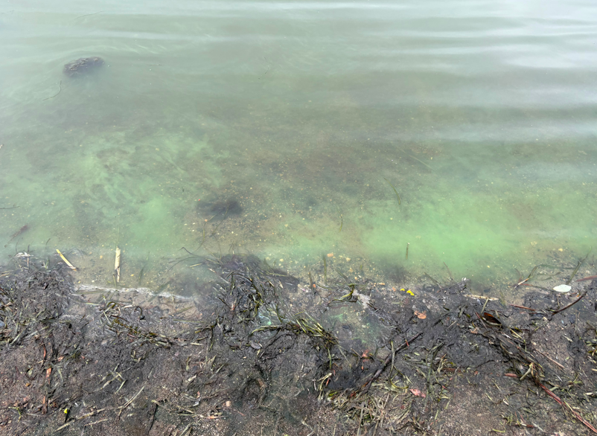
Have you ever wondered why a cyanobacteria bloom can make a pond smell... well, less than pleasant? The answer lies in the chemistry of the bloom as it grows, dies, and decomposes.
When a cyano-bloom occurs, it can form dense layers that block sunlight and limit photosynthesis, contributing to lower oxygen levels. As the bloom begins to die and decompose, bacteria break down the organic matter, consuming oxygen in the process. These biological processes can produce a variety of volatile organic compounds (VOCs), which are chemicals that easily turn into a gas at room temperature. VOCs can produce a wide range of odors, from earthy and pleasant to downright foul.
Two common odor-producing compounds associated with cyano-blooms are geosmin and 2-methylisoborneol (MIB). Geosmin is one of the main compounds responsible for the familiar earthy smell of fresh soil. MIB also produces a distinct earthy scent. Humans are incredibly sensitive to these compounds and can detect them at concentrations in the parts-per-trillion range!
What is it about the blooms that smell less like fresh soil and something fouler? Cyanobacteria blooms and the decomposition process that follows can release a wide range of VOCs beyond geosmin and MIB. Some of these odor-producing byproducts, like sulfur-containing compounds, can produce odors like the scent of petroleum or rotten eggs. During the decomposition process, oxygen becomes more depleted, so microorganisms shift to different decomposition pathways. These pathways can produce a variety of odor-producing compounds. Even at small concentrations, they can be potent, which is why a pond experiencing a large bloom can have a noticeable odor. Our Cyanobacteria Monitoring Program interns say, "You can smell it in the samples!"
Although you may smell geosmin, MIB, and other VOCs around a cyano-bloom, these compounds are not responsible for the toxic effects associated with some algal blooms. Some cyanobacteria blooms also produce cyanotoxins, which can be harmful to people, pets, and wildlife. Most importantly, you cannot determine if a bloom is toxic based on its smell alone, because regardless of the presence or absence of VOCs, cyanotoxins are generally odorless and require testing to confirm their presence.
To check if there is a cyanobacteria bloom at a pond near you, visit APCC’s interactive cyano map: |
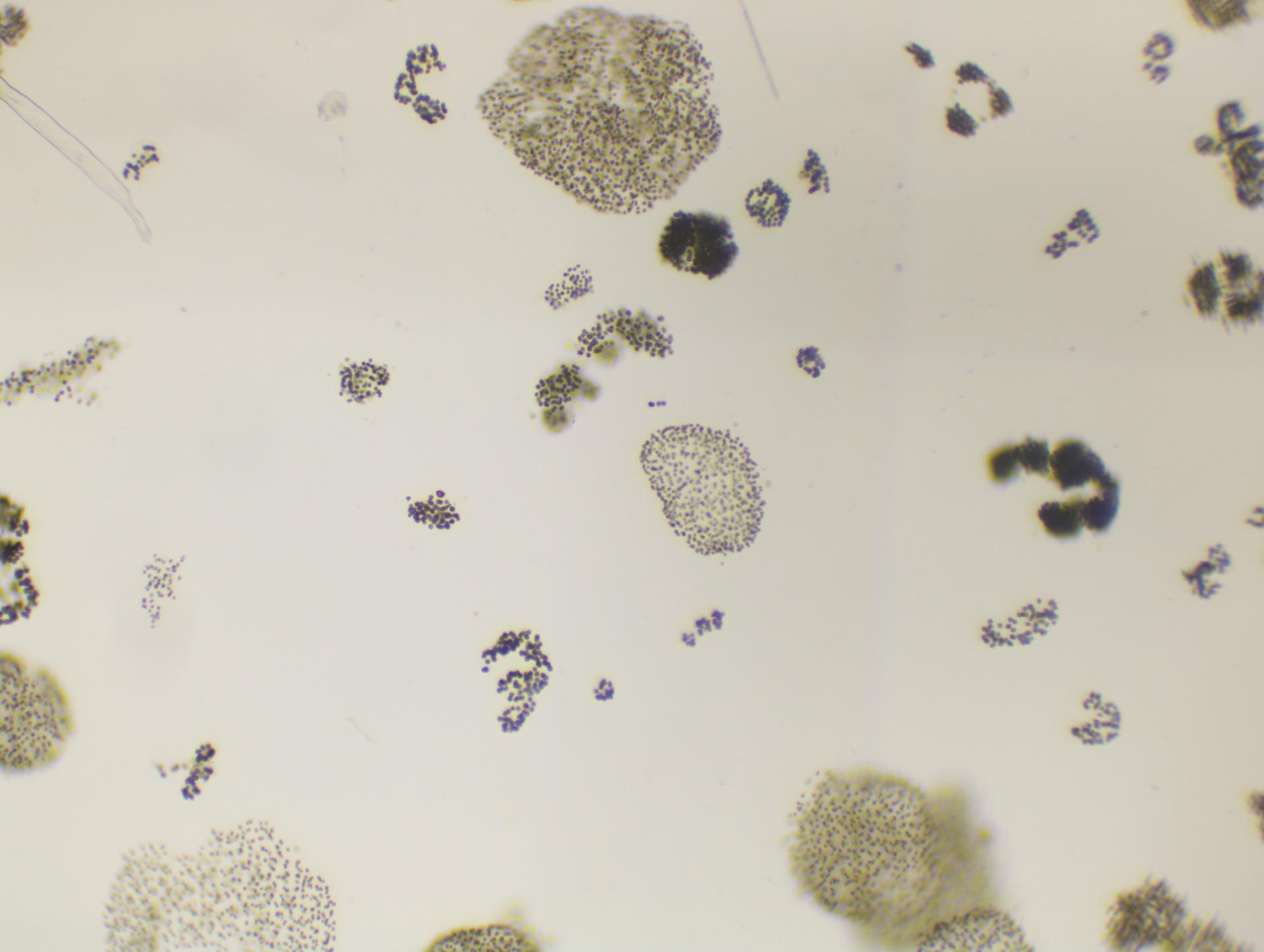
Above: Microcystis sp. in scum samples from West Reservoir, Harwich August 19, 2026. |
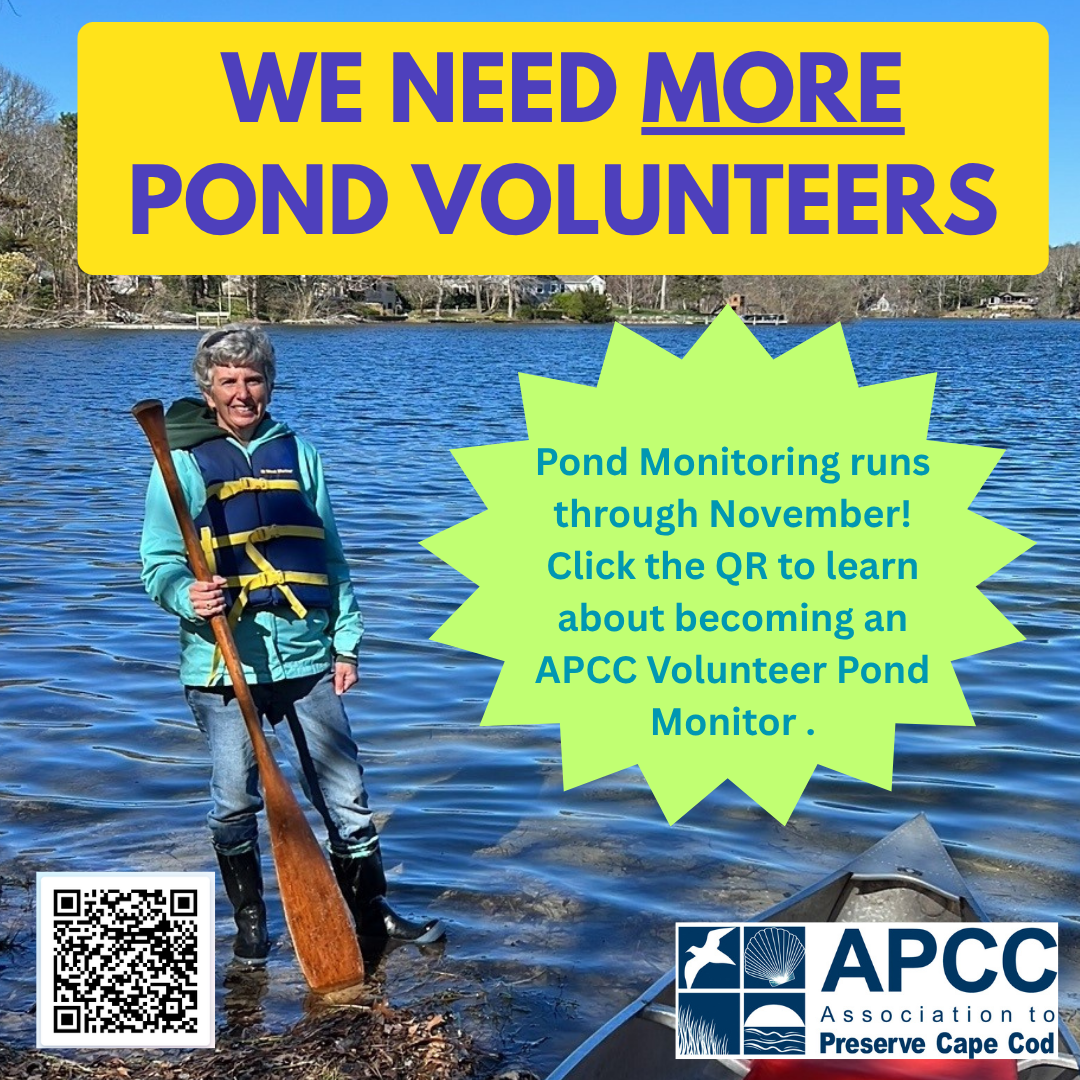
CALL FOR FALL POND MONITOR VOLUNTEERS! As APCC completes our last week of freshwater pond sampling for the month of August—with the help of our amazing volunteers, we’ve been able to grow our program to cover 73 ponds across the Cape this season. Although summer is coming to a close, we will continue to collect samples on the ponds through the fall and are looking for more volunteers to sign up to help. Volunteers can sign up for as many days as they like. Volunteers will work alongside an APCC technician. Shifts run from 7:30 a.m. - 1:30 p.m. Training and equipment are provided. NEW VOLUNTEERS CAN SIGN UP HERE. |
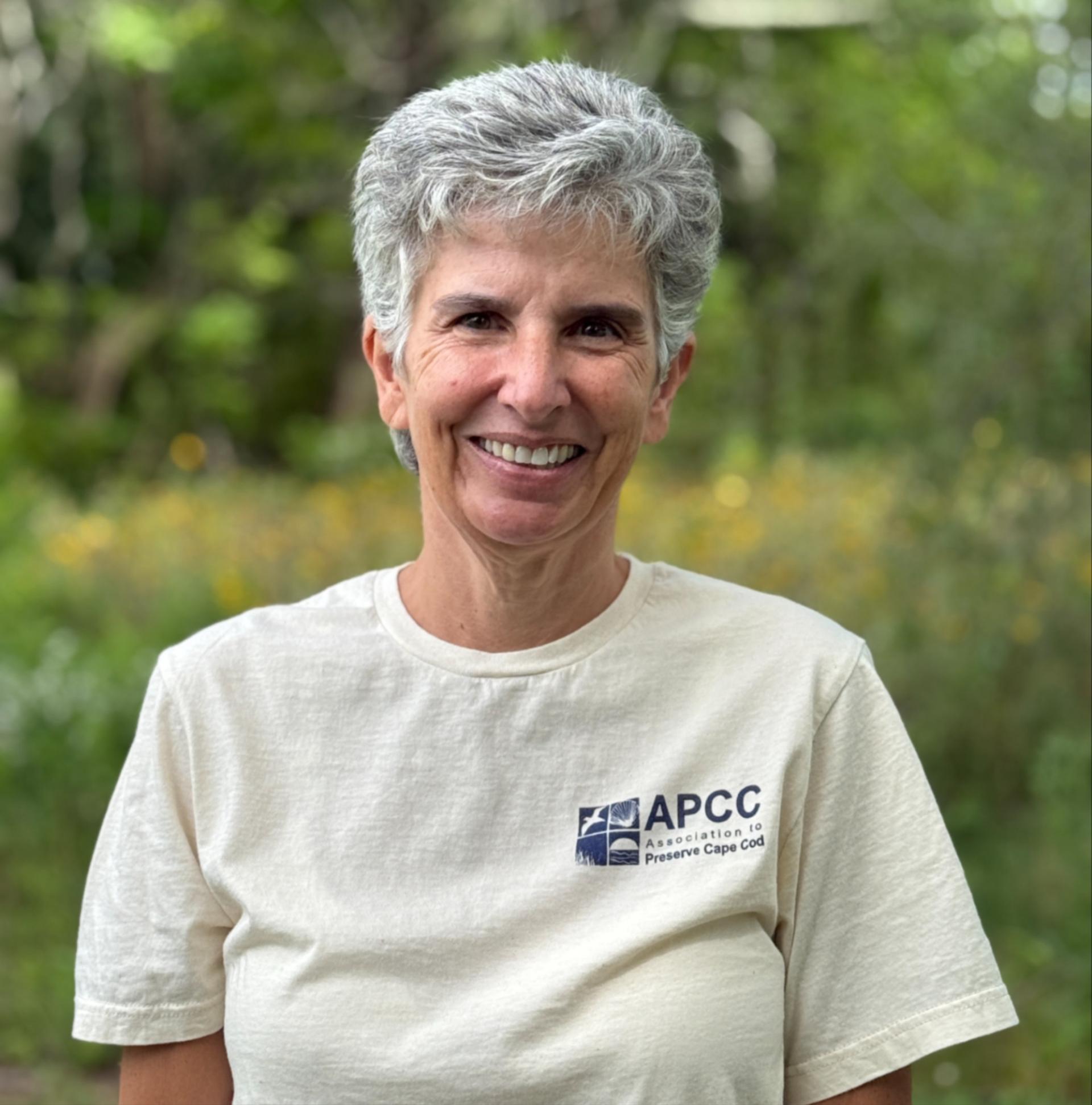
Above: Mary Crawford, APCC volunteer |
Mary Crawford is a third-season APCC volunteer who assists with the pond monitoring and eco-landscaping programs. After living in New Jersey, she moved to West Yarmouth about three years ago. Mary has always participated in some form of community service and discovered APCC through articles in the Cape Cod Times. She started volunteering at outreach events and later joined the pond monitoring and eco-landscape crews.
“What I really like about APCC is that it is involved in so many different aspects of conservation [and] preservation.”
Mary appreciates the educational aspect of volunteering, as many of the interns and technicians share their knowledge about ponds and native plants as well as at-home conservation strategies.
“I think it's great that it's not just come here and do this. It's, you know, why. It's education for me and for the other volunteers and I've learned just so much by doing it.”
Through volunteering with APCC, Mary has learned about the Cape’s kettle ponds and freshwater systems, as well as how small actions can make a positive impact on the environment. Mary also encouraged friends and family to volunteer with APCC because of the many ways they can become involved.
“I always [mention] APCC because there's so many different ways to get involved. And there's so much learning and education that they provide. That [APCC] is one of the best organizations I think on the Cape as far as volunteering… They're very dedicated to not just doing work but also spreading the word and educating everybody along its way.” |
Fare Thee Well.... Watch this space! As the season draws to a close for our seasonal interns, over the next few weeks we will share with you what they told us about their experience here at APCC. We hope they will inspire you with hope for the future as much as they do us. |
Restoration Intern, Ryan Weinsier |
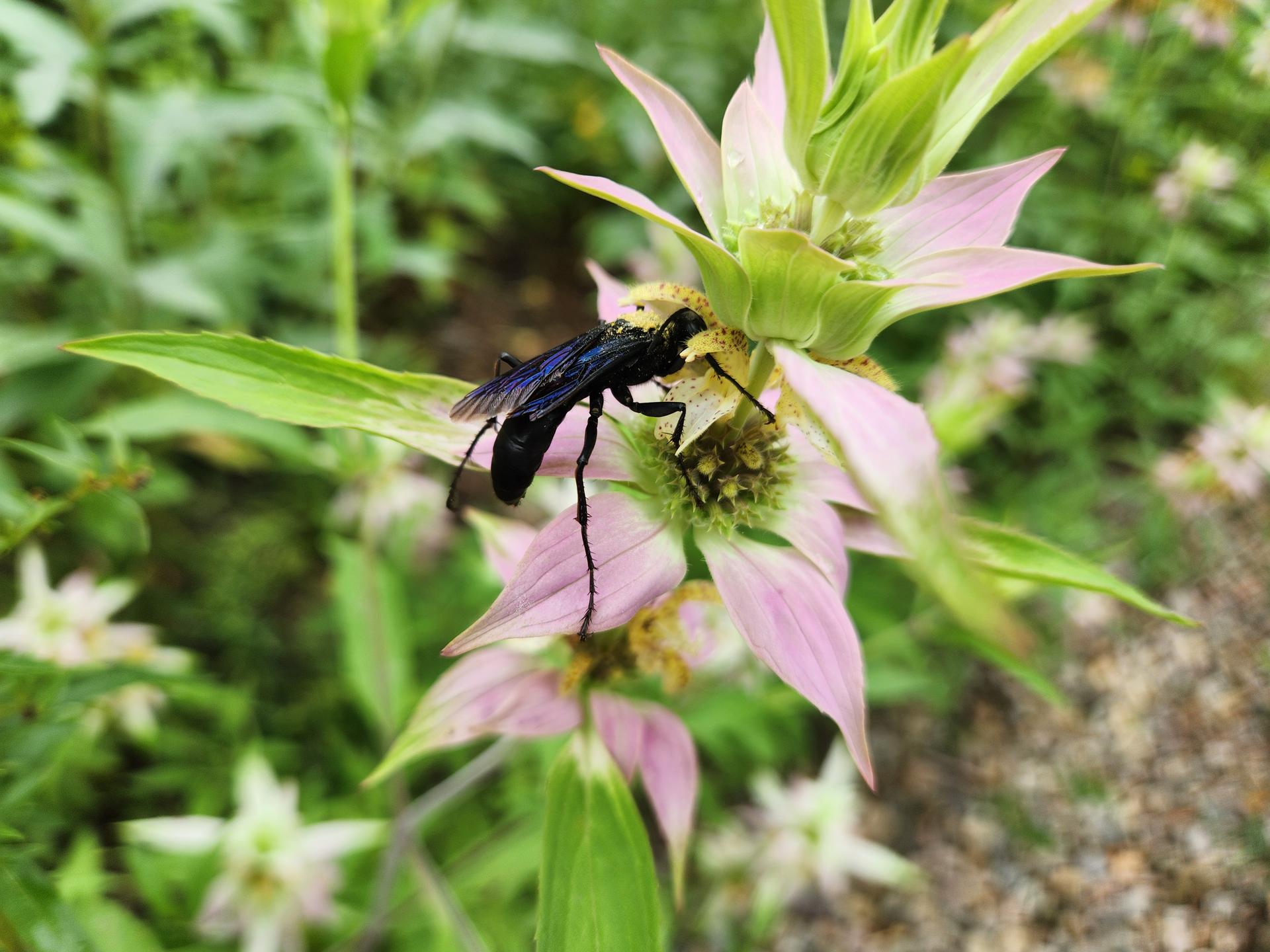
Above: Great black digger wasp, Sphex pensylvanicus, on spotted bee balm, Monarda punctata |
The Great Black Digger Wasp
The adults of this native wasp primarily eat nectar and prefer species with shallow flowers, such as spotted bee balm (Monarda punctata) and milkweeds. These wasps are important pollinators. Watching this female on the bee balm, it was interesting to see how the anthers of the flower dangle above the entrance for the nectar. Her thorax readily brushed against them, coating the hairs with pollen, giving her an appearance of wearing a mink stole. These wasps are important pollinators.
The great black digger wasp is a solitary nester, which means it is the female that digs a burrow where she lays an egg. Unlike the adult, the great black digger wasp larva will require insect protein to develop. Therefore, the wasp hunts about the landscape for a katydid or grasshopper to sting multiple times—paralyzing, but not killing it—before she lays an egg on it and closes it in the shallow burrow she had excavated. The unlucky insect will serve as fresh food for the larva when it emerges from the egg.
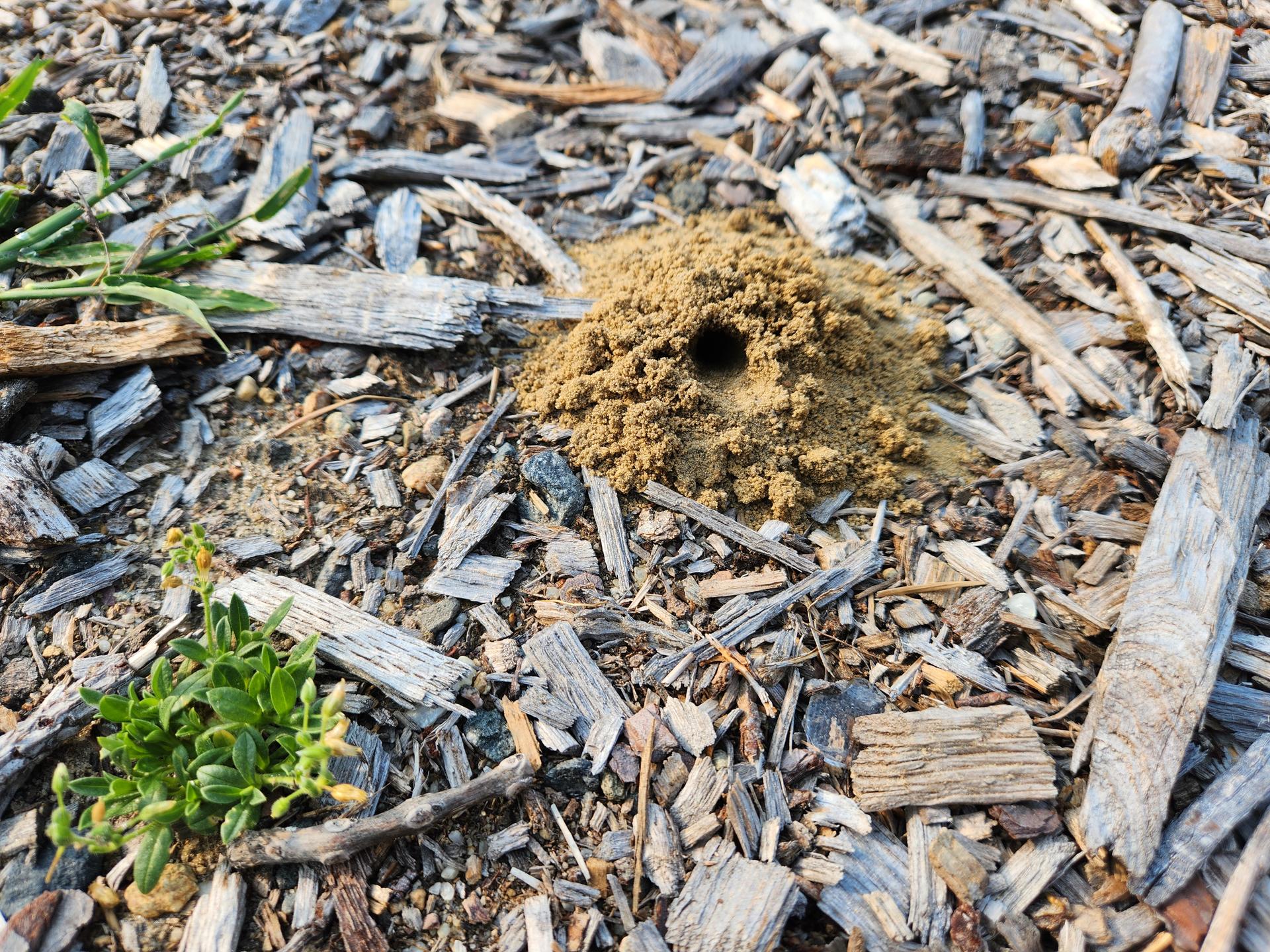
It's important to note that she is not territorial, nor protective of her burrow—in fact, you probably will not know where she has dug her burrow unless you see what we saw (see photo below). Unlike social ground-nesting yellow jackets that readily defend their nests when threatened with disturbance, these wasps are very docile and just go about their job in the landscape.
It's extremely unfortunate that when you search on the web for information on this stunning creature, many of the first sites that pop up are for pest control companies. Let's change the algorithm! |
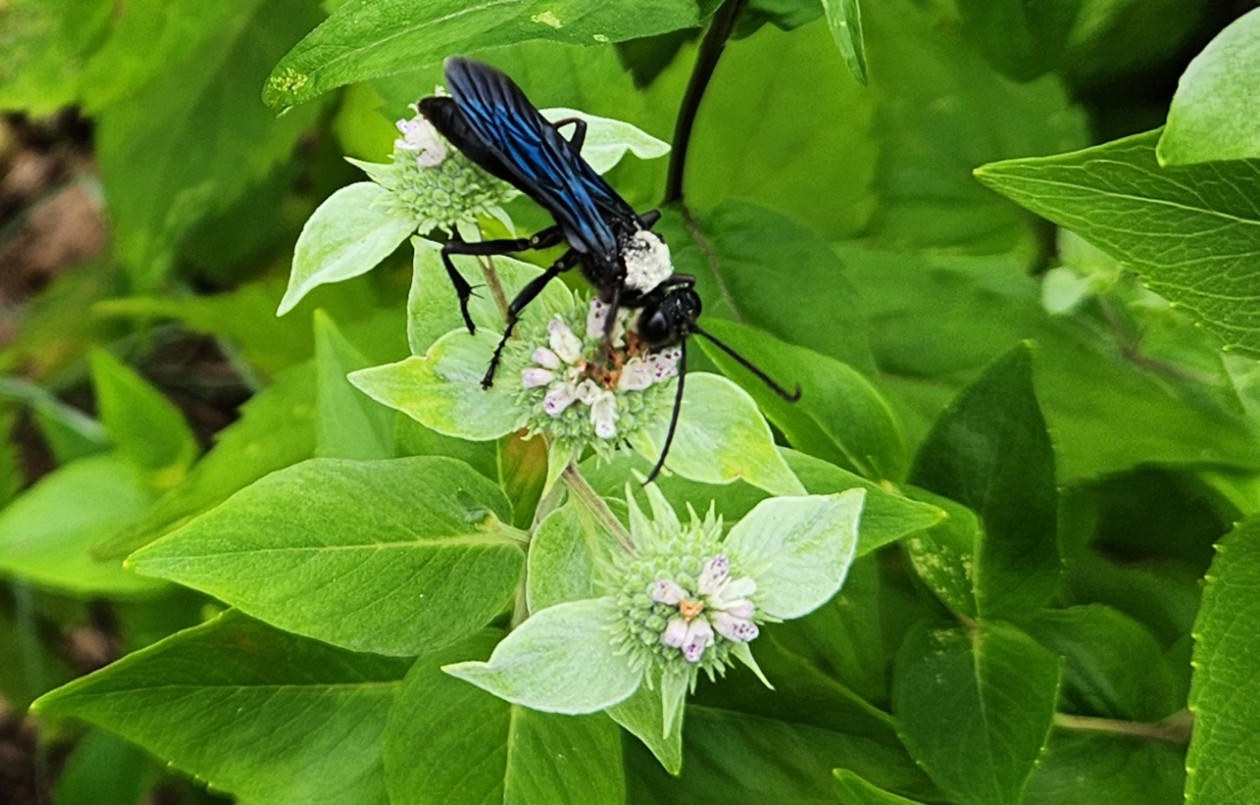
Above: Great black digger wasp on short-leaved mountain mint |
|
|
|
Above: While we don't know for certain, this looks like it may be a burrow for a digger wasp. |
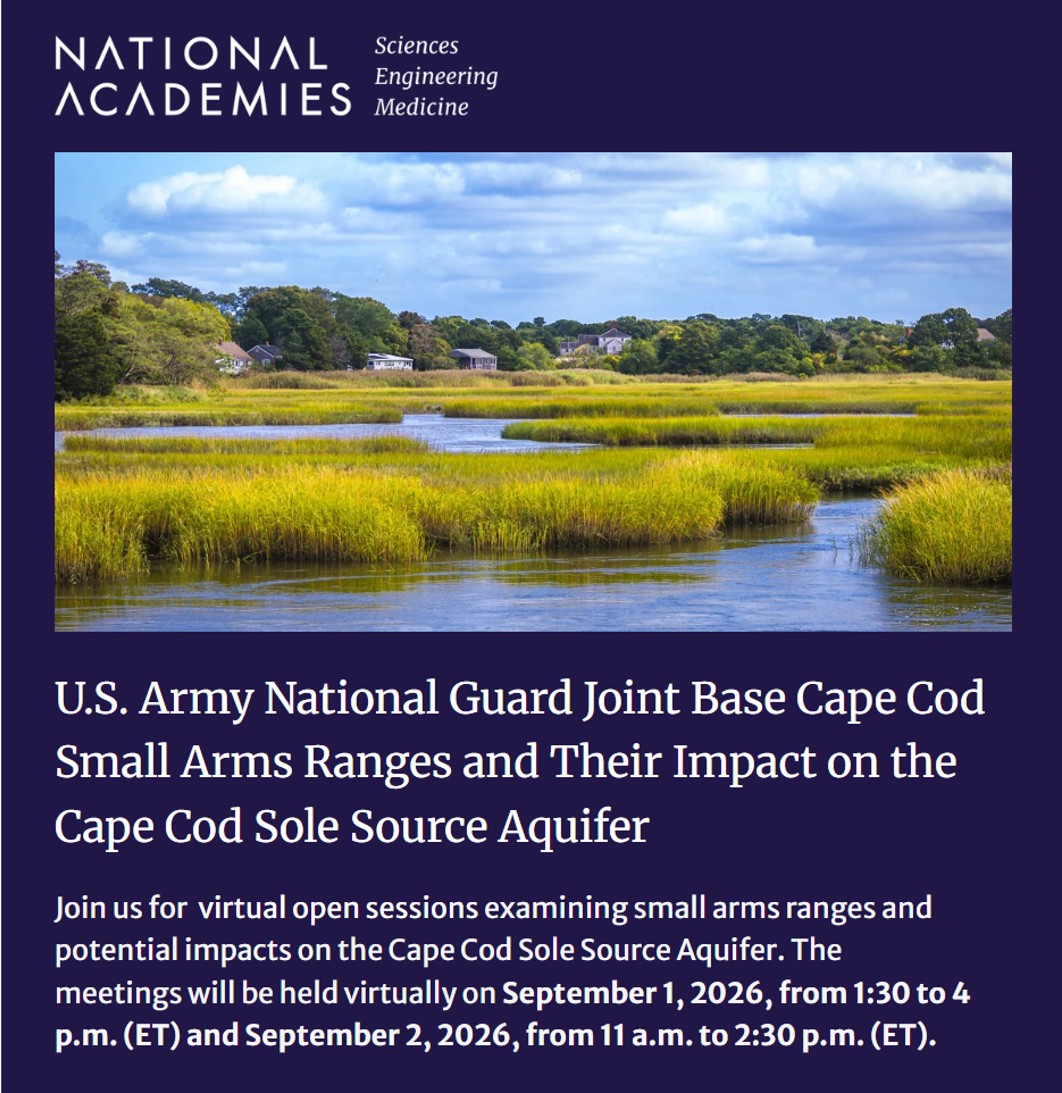
A committee of experts will carry out a consensus study examining potential groundwater contamination from small arms ranges at the Massachusetts Army National Guard's Camp Edwards. The study will assess the current state of soil and groundwater contamination, monitoring plans, mitigation strategies, and hydrologic and water quality models related to contaminants from small arms ranges.
The National Academies are convening the first virtual open sessions of the committee. The meetings will provide background on the history of small arms training at the base, contaminants of concern, past mitigation efforts, and potential future issues associated with the planned range. It builds on a 2024 meeting of experts that examined scientific and technical issues related to potential impacts on the aquifer.
Committee members will hear from representatives of the following organizations:
Massachusetts Army National Guard U.S. Environmental Protection Agency U.S. Geological Survey Massachusetts Environmental Management Commission Cape Cod Commission. |
|
|
|
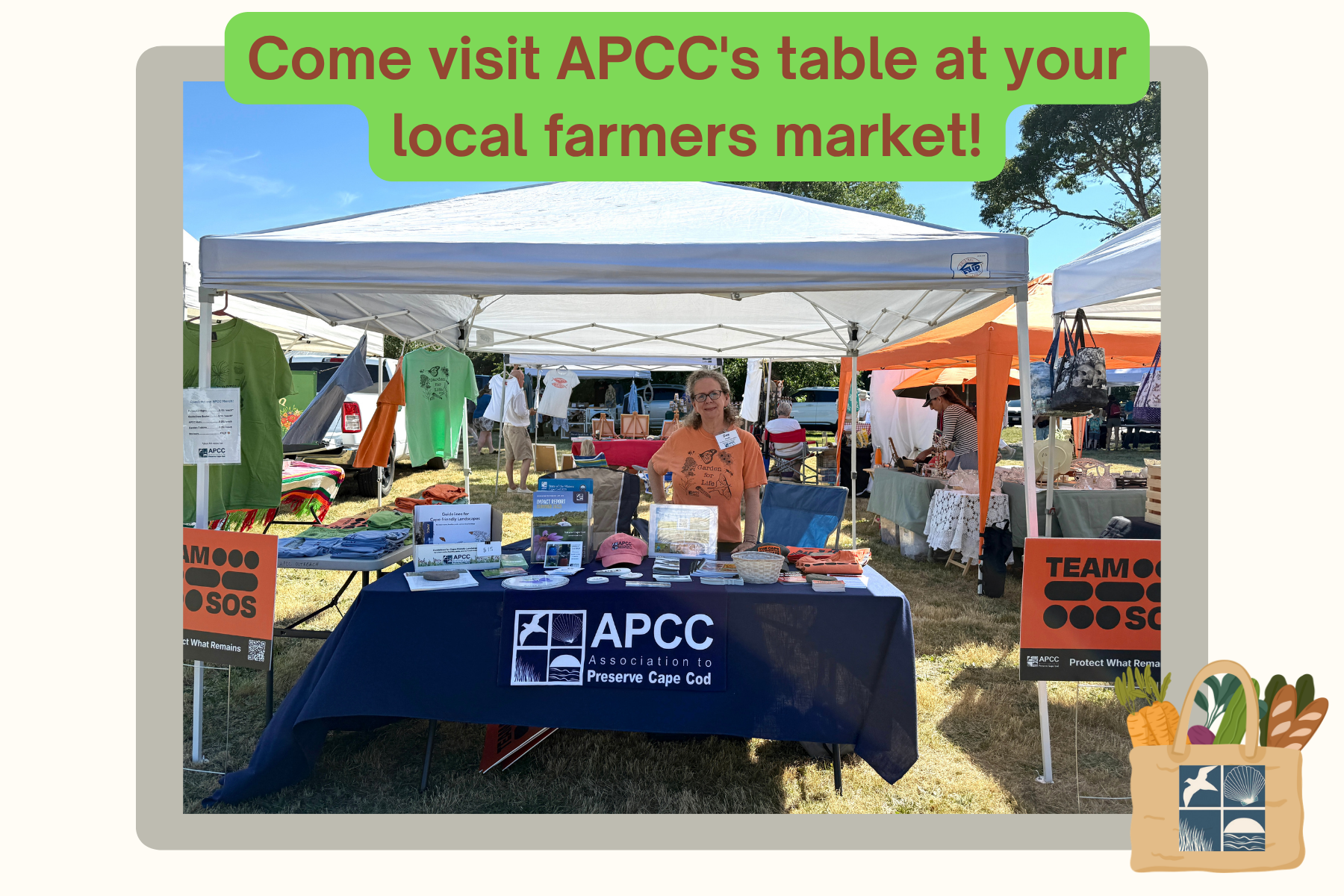
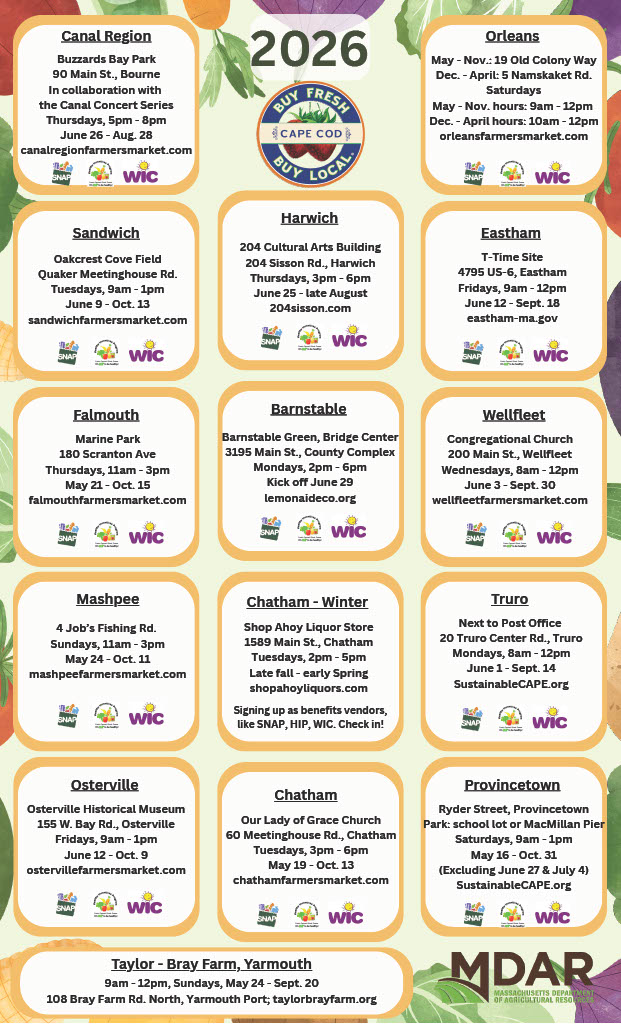
We are trying to be at as many farmers' markets as possible this season to talk about APCC programs, including The Cape We Shape. Below is a list of where and when you can support your local farmers. |
APCC is Partnering with Planetary Health Alliance SAVE THE DATES
Planetary Health Stories: A Community Arts & Storytelling Project
Join us this fall for a two-part series that brings women together to share, through writing, poetry, art, and photography, what they are witnessing, grieving, and hoping for as climate change, biodiversity loss, pollution, and changes in food systems reshape the places they call home.
This project, led by Jennifer Rasmussen and Tatiana Camargo through the Planetary Health Alliance, gathers stories from communities around the world, showing how women and girls everywhere are feeling these changes, and how they're finding ways to grieve, cope, and create in response. The stories collected will become part of a collaborative book, which will serve as a reminder that personal memory and lived experience are just as powerful as science in helping us understand what's happening to our planet, and in connecting us to one another.
Part 1: Webinar
Thursday, September 10 | 5:30–6:30pm | Virtual
Facilitator Jennifer leads a one-hour orientation covering what planetary health means, the story behind this project, and what to expect at the in-person workshop, plus an introduction to the volunteer team.
Part 2: In-Person Workshop
Friday, September 18 | 10:00 am–12:00 pm | Koppel Center, APCC
A relaxed morning of open creative time: writing, drawing, painting, photography, fiber arts, or simply reflecting alongside natural objects you bring from home. Includes a grounding exercise, guided creative time with volunteer support, a written reflection, and a closing circle where participants can choose to share and reflect on their art. This series is open to all women – no artistic experience necessary. With permission, stories and artwork may be included (anonymously) in the Planetary Health Alliance collaborative book. |
|
|
|
A Cape-wide Conservation Event Calendar |
The Compact of Cape Cod Conservation Trusts (“the Compact”) and its nonprofit members launched a new regional calendar of events. The Conservation Calendar includes programs across Cape Cod hosted by these groups. The goal of the calendar is to encourage visitors and residents to take part in nature and environmental events. You can always find the link to the calendar on APCC's website under News & Events.
|
If you are a farmer or someone who wants to grow native plants to sell, or you just want to be updated on the program's development, please submit the interest form that appears on our webpage. We will be sending periodic email notices of workshops and meetings.
Funding for the project is provided by Barnstable County and its Economic Development Council License Plate Grant Program through the Cape Cod Commission, the Kelley Foundation and private donors. |
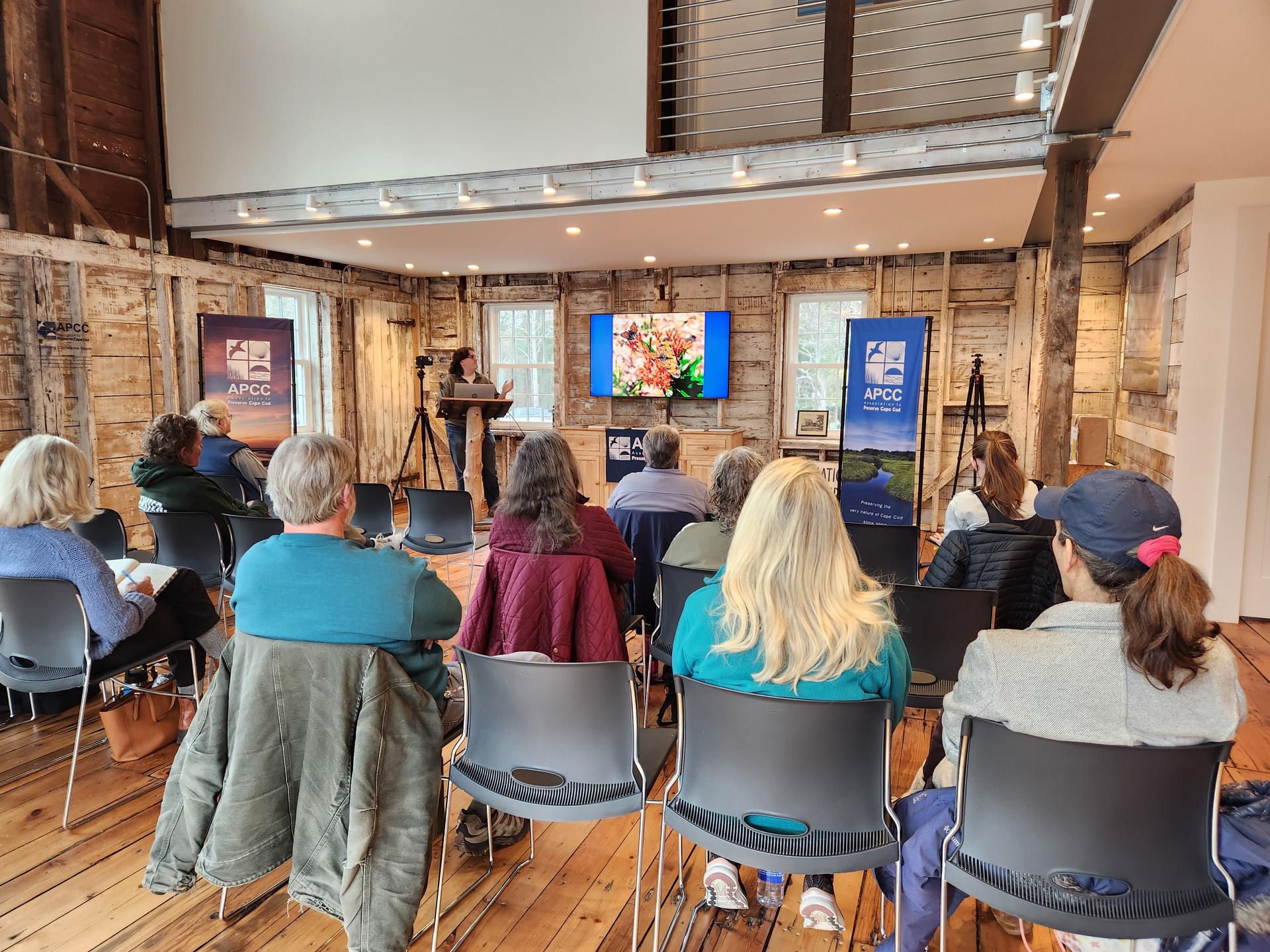
Ten talks for prospective growers as part of the Cape Cod Native Plant Growers' Cooperative program have been presented thus far, with more scheduled in the upcoming weeks. These past workshops can be viewed here: |
A Cape Cod Native Plant-selector ~ to help you choose the perfect native plants for your garden. |
|
|
|
Email kandres@apcc.org and we'll send you a CapeCodNativePlants.org decal. |
|
|
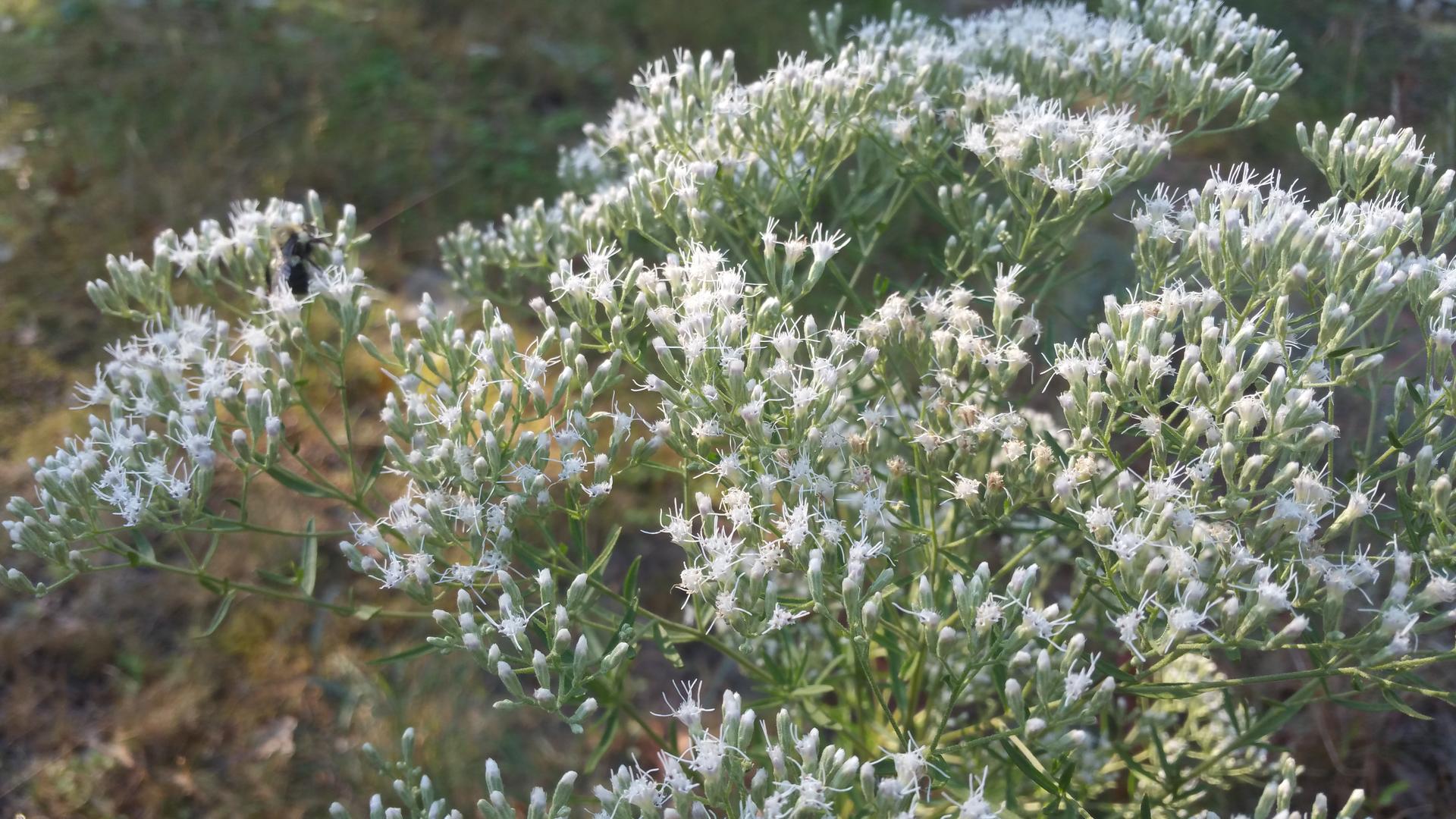
Hyssop-leaved Boneset
Eupatorium hyssopifolium |
|
|
|
The purpose of CapeCodNativePlants.org is to help native plant enthusiasts select the right plant for the right place. While not all native plants presented here are indigenous to Cape Cod, they are suitable native species for Cape gardens and managed landscapes.
Why Native Plants? Many native plants are drought tolerant, salt tolerant, and thrive in the “thin” soils found on Cape Cod. Native plants are as attractive as any plant, and are reflective of the Cape’s natural beauty. By planting native species appropriate for Cape Cod, you can conserve water, avoid pesticide and fertilizer use, and support pollinators and birds.
|
|
|
|
|
The Guidelines gives homeowners steps they can take in the design and maintenance of their properties that will support pollinators and birds, manage stormwater, conserve water, and protect the Cape's water quality. This 40-page booklet is beautifully illustrated by Marcy Ford with content that is easily digestible and supported by numerous resources for additional learning.
| |
|
|
We are grateful for the several retail shops that are partnering with us to make this publication more widely available: Brewster Book Store, Birdwatchers General Store, Crocker Nurseries, Wellfleet Audubon Wildlife Sanctuary, Cape Abilities Farm, Cape Cod Museum of Natural History, the Cape Cod Lavender Farm, Heritage Museums and Gardens, Titcomb's Bookshop, Sea Howl Bookshop, Soares Flower Garden Nursery, Hyannis Country Garden, Orleans Whole Food Store, and Eight Cousins Bookshop.
Heard it makes a nice gift for a neighbor or for a housewarming or host(ess) gift!
If you are a retailer and would like to sell this publication at your store, please contact us. |
|
|
|
| APCC eNewsletters Our weekly newsletters are archived on our website and easily shared.
You can find past newsletters and share with your friends. Encourage others to sign up for future enewsletters HERE.
|
|
|
|
Are you thinking of going solar? We hope so!
In partnership with E2 SOLAR in Dennis, APCC receives $500 for every solar installation when APCC is named as referral. |
|
|
|
|
Thank you to the homeowners who just contracted to install solar panels through E2 Solar. May the sun always shine for you! |
|
|
|
Expressions Gallery, 578 Main Street, Chatham
CLICK HERE |
Expressions Gallery donates 20 percent of its profits to APCC's work. |
|
|
|
Thank you to our business sponsors! |
|
|
|
APCC is rated four stars by Charity Navigator, 2026 Platinum by Candid (formerly Guidestar). |
|
|
|
Our Contact Information
*{{Organization Name}}*
*{{Organization Address}}*
*{{Organization Phone}}*
*{{Organization Website}}*
*{{Unsubscribe}}* |
|
| |
|
|