Association to Preserve Cape Cod |
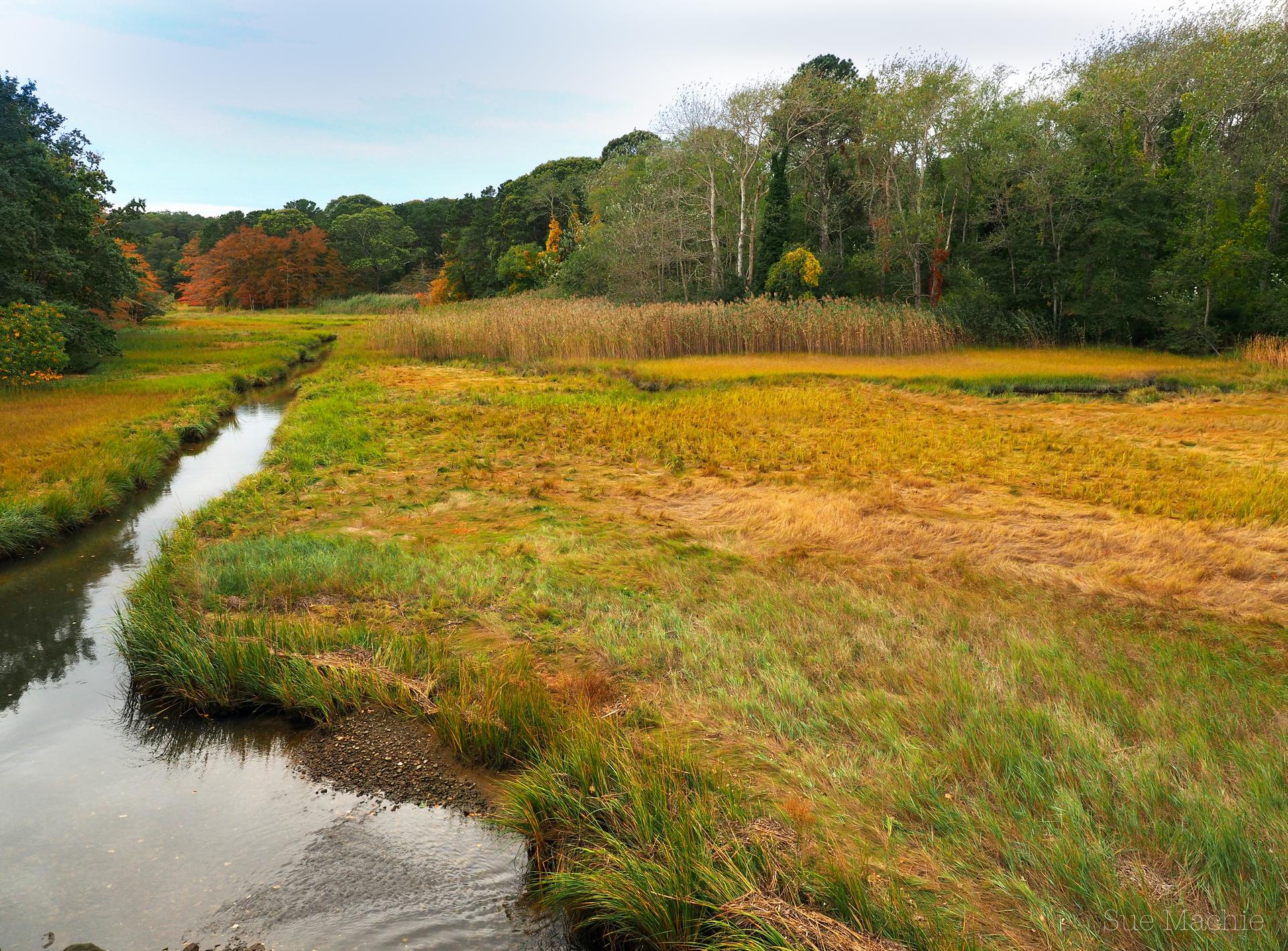
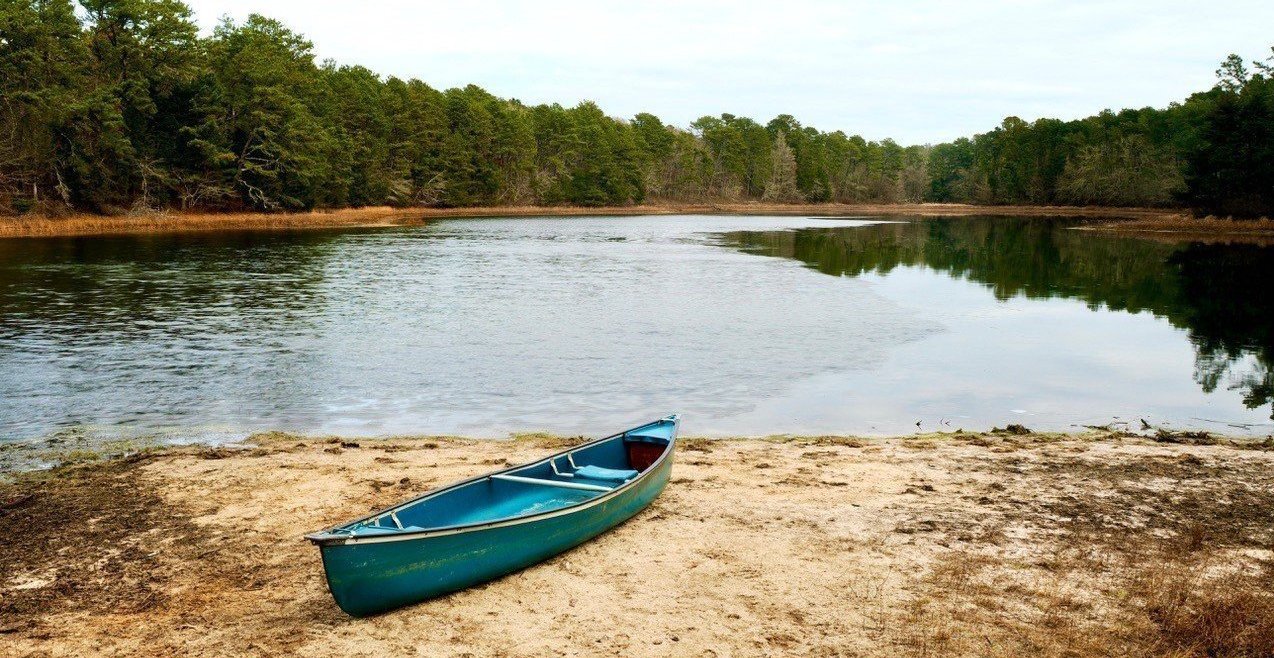
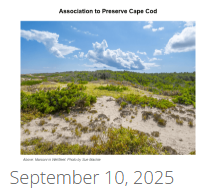
Above: Orleans salt marsh. Photo by Sue Machie |
|
|
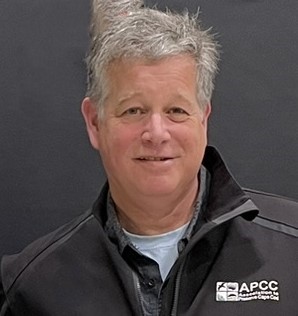
| Volunteer Appreciation by Andrew Gottlieb, Executive Director |
APCC is widely known for batting above our weight. Part of the reason our very talented but relatively small staff can cover so much ground is the help we get from our dedicated volunteers. Over 300 volunteers give their time to support our work in every way imaginable. Volunteers collect water samples, work on our landscape, represent APCC at public events, take the photos that document our work, help with mailings and so much more.
|
|
|
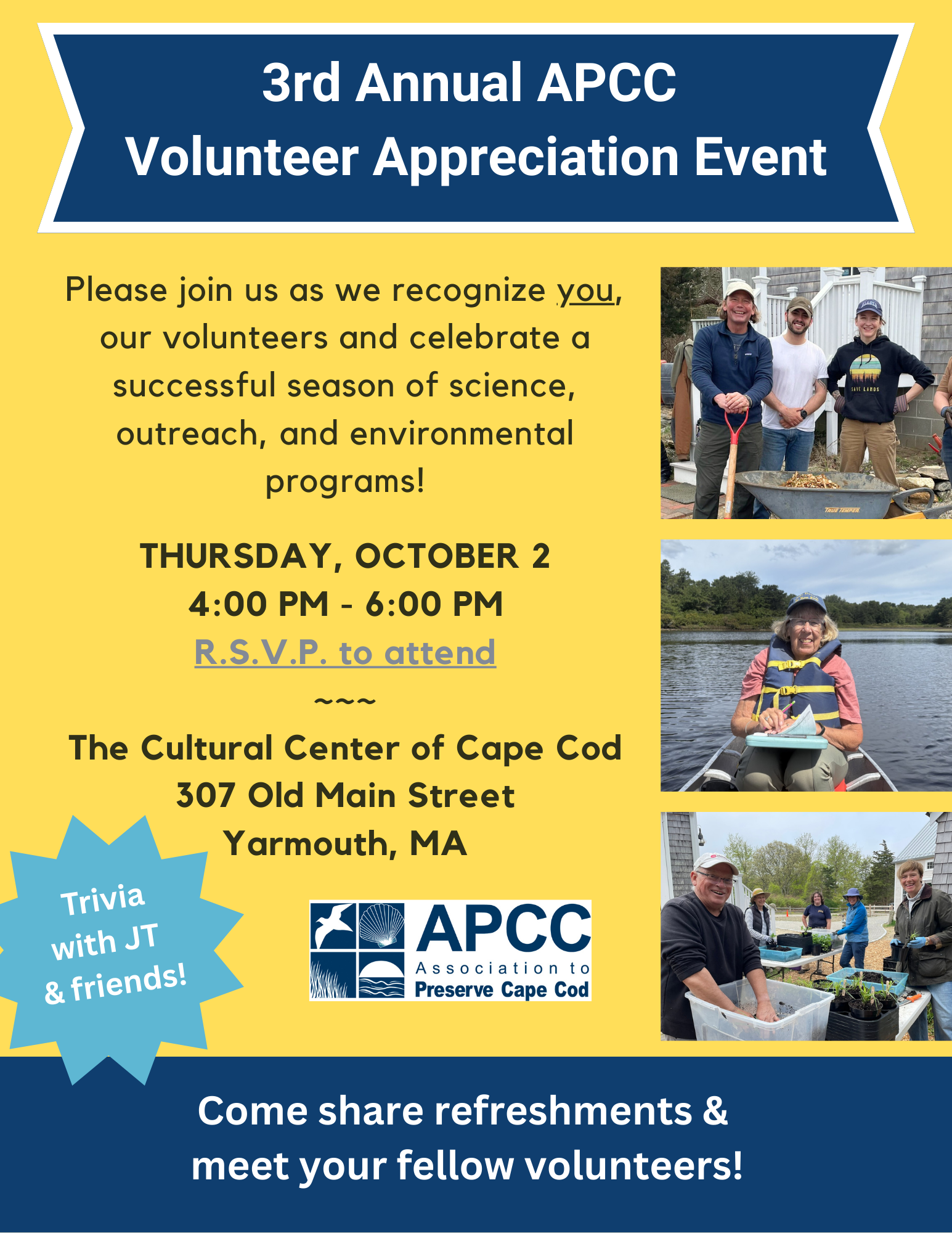
Simply put, APCC would not have the breadth of programs or have the impact we do but for our volunteers. While we are holding our annual volunteer appreciation event this week to thank those in attendance personally, this is a great time to thank our volunteers more broadly.
From what I hear, our volunteers find their service rewarding for several reasons that include making a difference on behalf of the environment, learning about resources as they work alongside staff and other volunteers, and getting to know our wonderful staff. Those are all great reasons for those who volunteer to continue to do so and for those who have not yet had the experience to give it a try.
With more of you at our side, there are few limits on what we can accomplish for Cape Cod. |
APCC Ecosystem Restoration Program |
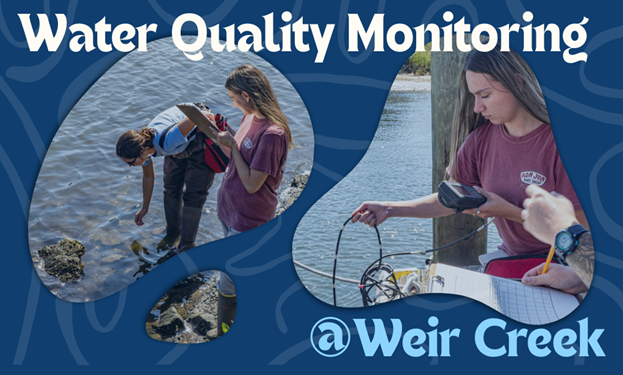
This summer marked the second season of water quality monitoring at Weir Creek in West Dennis. From June through September, APCC’s Ecosystem Restoration Program staff and volunteers conducted twice-monthly visits to five monitoring sites, with a focus on culvert areas where tidal restrictions and runoff have the greatest influence on water conditions.
At each site, salinity, dissolved oxygen, temperature, and conductivity were measured, along with water samples collected for lab analysis. Samples were filtered at APCC and then sent to the Center for Coastal Studies for testing nutrients, including nitrogen and phosphorus concentrations. Elevated nutrients can fuel algal blooms and reduce dissolved oxygen, degrading habitat for fish and other aquatic life. The data collected this season will help guide future restoration and management efforts. By documenting how water quality changes over the summer and how culverts shape ecosystem health, this work builds the knowledge needed to protect and restore the creek for years to come. |
|
|
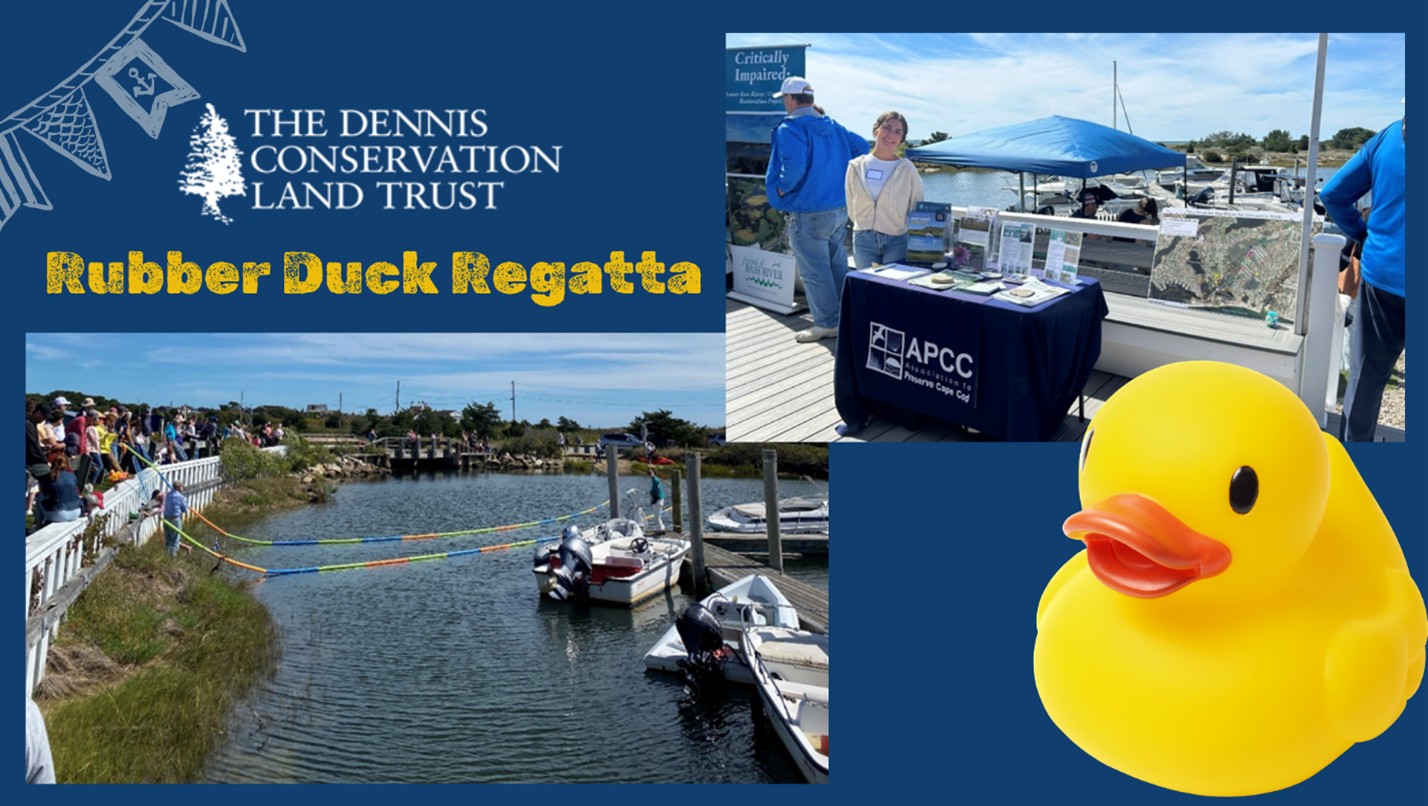
Thank you to the Dennis Conservation Land Trust for hosting the Association to Preserve Cape Cod at their annual Rubber Duck Regatta at the West Dennis Yacht Club! It was a wonderful event full of family fun and provided APCC with the opportunity to share information regarding the nearby Weir Creek restoration project with the local community.
For more information about the Weir Creek restoration project or to sign up for regular updates, please visit the project website. |
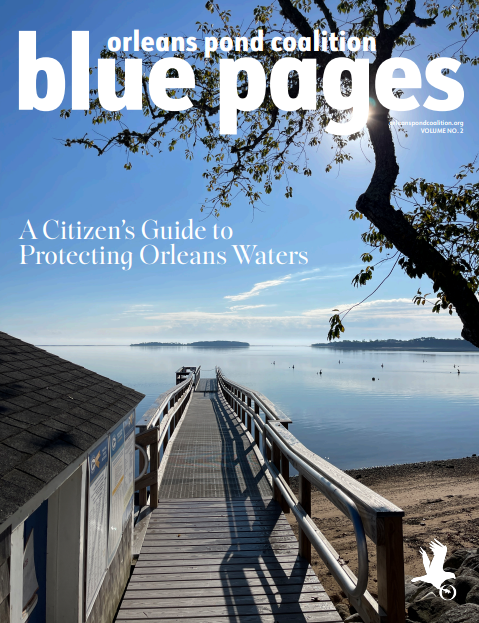
Orleans Pond Coalition announces its release of the new and updated Blue Pages—check it out. |
|
|
A Wonderful Season on the Ponds for the Cape Cod Regional Pond Monitoring Program |
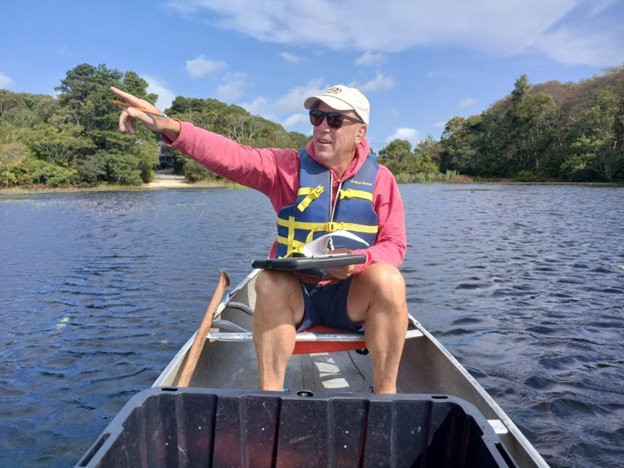
Above: Douglas Moran on Lake Elizabeth, Barnstable |
It’s been a fantastic season for the Cape Cod Regional Pond Monitoring Program. Our dedicated volunteers have joined APCC’s pond monitoring technicians, May and JT, on ponds across the Cape four days each week, collecting valuable water quality data as part of the Cape Cod Commission Freshwater Initiative.
September sampling has just wrapped up, and as the leaves begin to turn, May and JT are looking forward to enjoying the crisp fall air and beautiful foliage alongside our incredible volunteers.
If you are curious and want to take a peak at the data being collected by the program, please check out the Cape Cod Commission’s Freshwater Portal! |
|
|
Cape Cod Pond Watchers Bio-survey Program
~ a training video on how to use the Survey123 app to log your observations in pondside! |
| |
|
APCC's Cyanobacteria Monitoring Program |
|
|
|
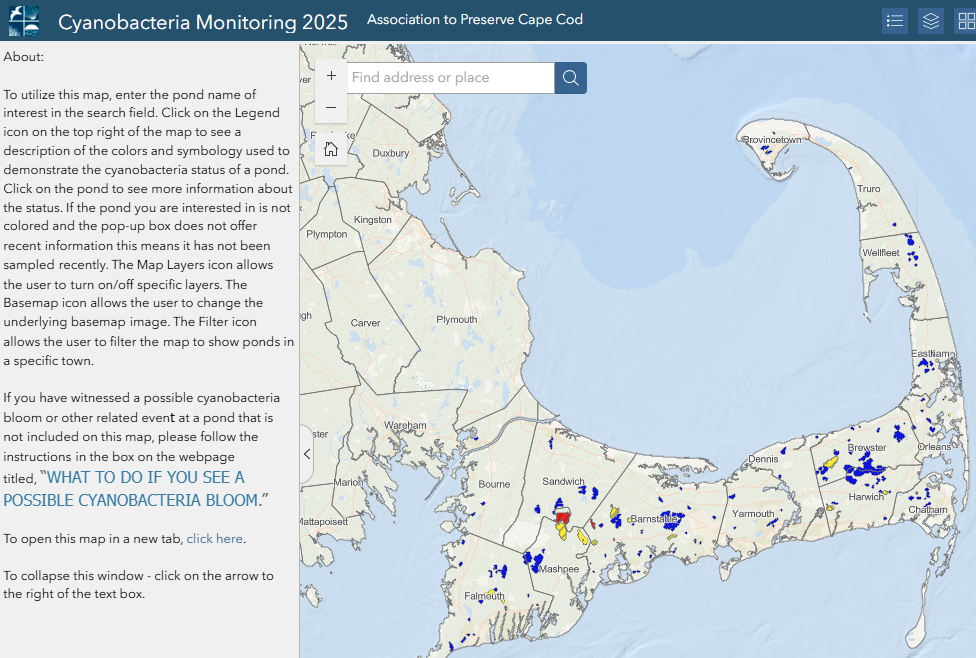
Check on the status of your favorite pond on our interactive map. If you see what appears to be a bloom, take a picture, note the day, location, and time and notify the local health department, and email to cyano@apcc.org.
Sign up for cyanobacteria email alerts.
Please note: The cyanobacteria alert is only sent out when a concern is first identified at a pond. All updates following this initial notice are shared on APCC’s interactive map. |
|
|
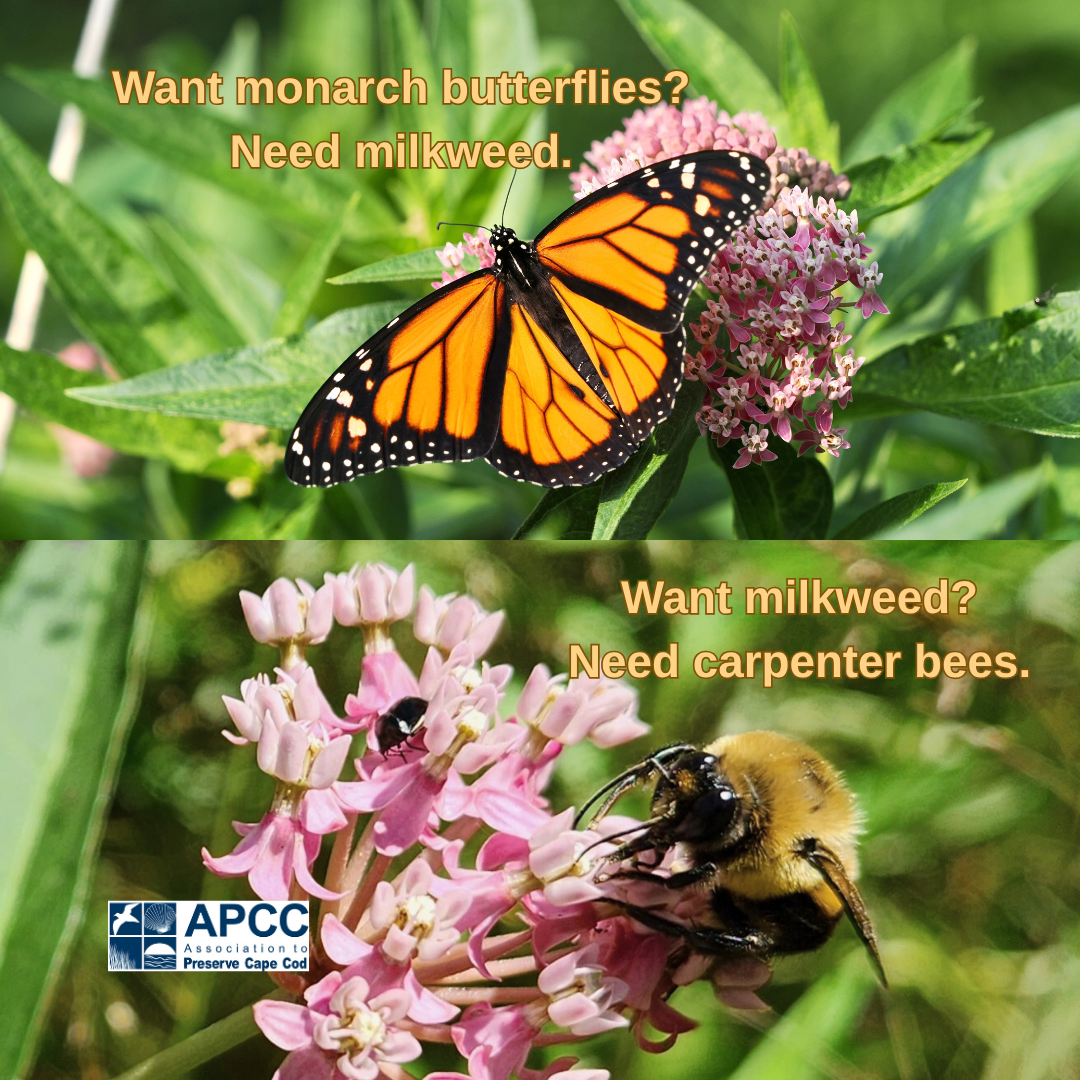
Want Monarch Butterflies? Need Milkweed
Want Milkweed? Need Carpenter Bees
You may know the carpenter bee—the biggest of our native wild bees—about the size of a Brazil nut, or if you haven’t seen a Brazil nut in a while, they are about an inch long. They are distinguished from bumble bees by their hairless, shiny, black abdomen.
The big carpenter bee is the only bee that is capable of pollinating milkweed. This is because, unlike most flowers, the pollen of milkweed is sticky and in clusters, called pollinia, which are designed to stick to an insect’s leg. They are held beneath a tiny slit between the anthers. When a nectar feeding insect’s leg slips into this opening and then pulls its leg out, the pollinia is likely stuck to it and then transferred to the next milkweed flower.
However, this poses a problem for most insects because they don’t have the strength to retrieve their legs—which often results in them leaving a leg behind or die stuck. Only the carpenter bee is “strong like bull” and can effectively muck around on milkweed without mishap. And since monarch butterflies are dependent on milkweed for their life cycle—no milkweed, no monarchs—that means monarchs need carpenter bees. If we want to see monarch butterflies, we need to accept the carpenter bee’s valuable role in pollinating milkweed.
Our wild bees need our support. You can do this by avoiding the use of pesticides outside—even if it's organic or a homemade concoction because if it kills, it will kill bees. And of course, skip those lawn treatments that are likely more than just fertilizer: They can also include herbicides, insecticides and fungicides. Leave wild areas in your yard and be certain to leave some dead wood for the boring bees like the big carpenter bee. They all have the very important job of pollination.
|
Please Help Us Put Protection of Nature on the Ballot! APCC and a coalition of over 50 organizations (Nature for Massachusetts Coalition) are pursuing a "Protect Water and Nature Initiative" as a question on the November 2026 ballot. The effort would set aside revenue from the existing state sales tax on sporting goods to dedicate $100 million every year for protecting and conserving water and nature—without raising taxes. We need to collect over 100,000 signatures between September and this November to get the initiative on next year's ballot.
If you would like to help us get the needed signatures, CLICK HERE for more information and to volunteer.
It’s time to invest in our future. Clean water, healthy forests, more trails and parks,
and access to the outdoors and nature for everyone. ~~~~~~~~~~~~~~~~~~~~~~~~~
At the same time we are collecting signatures, there is also a legislative effort: An Act Providing Nature for All. Here is the link to Bill S.2571.
|
|
|
APCC Upcoming Events and Workshops |
|
|
| APCC presents
Nibbling on Native Plants in Your Back Yard and Beyond
Wednesday, October 8, 2025 10:00 a.m. - 12:00 p.m.
In person at the Koppel Center at APCC headquarters and virtual |
|
|
This event is hybrid and Russ's presentation will be recorded.
Seating is limited. Virtual attendance is unlimited. The event is free.
For more information and to register, CLICK HERE. |
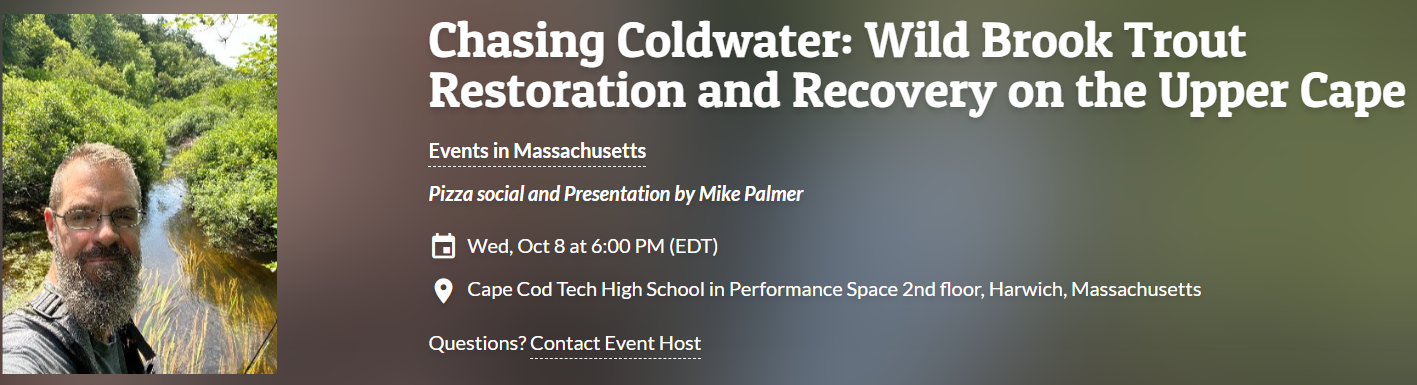
Wednesday, October 8th at 6 p.m. at the Cape Cod Tech High School in Performance Space, 2nd floor, Harwich, this presentation will explore recent analyses of brook trout biology on the Quashnet River, share findings from post-restoration recovery monitoring on the Childs River, and highlight ongoing restoration efforts on Red Brook, the Quashnet, and the Mashpee River. Together, these case studies illustrate how collaborative, science-driven projects are advancing coldwater habitat restoration across the Upper Cape.
The speaker is Mike Palmer is a restoration ecologist with the Association to Preserve Cape Cod (APCC), where he leads freshwater restoration projects—including fish passage improvements, retired cranberry bog restoration, and river restoration—while also coordinating the organization’s volunteer river herring monitoring program. |
|
|
|
Join the Brewster Ponds Association and Regenerative Agroecologist Peter Jensen from Terra Firma Permagardens for an enlightening talk, “Zen and The Art of Watercycle Maintenance: An Agroecological Educational Journey, Bringing a Global Approach to Solving Cape Cod's Ecological Challenges.”
This informative talk will be held on Thursday, October 2nd, from 4:30 - 6:00 p.m. at the Brewster Ladies Library.
This free event is open to the public; please register. |
|
|
A Cape-wide Conservation Event Calendar |
The Compact of Cape Cod Conservation Trusts (“the Compact”) and its nonprofit members launched a new regional calendar of events. The Conservation Calendar includes programs across Cape Cod hosted by these groups. The goal of the calendar is to encourage visitors and residents to take part in nature and environmental events. You can always find the link to the calendar on APCC's website under News & Events.
|
If you are a farmer or someone who wants to grow native plants to sell, or just want to be updated on the program's development, please submit an interest form that appears on our webpage. We will be sending periodic email notices of workshops and meetings.
Funding for the project is provided by Barnstable County and its Economic Development Council License Plate Grant Program through the Cape Cod Commission. |
|
|
A Cape Cod Native Plant-selector
~ to help you choose the perfect native plants for your garden. |
|
|
Email kandres@apcc.org and we'll send you a CapeCodNativePlants.org decal. |
|
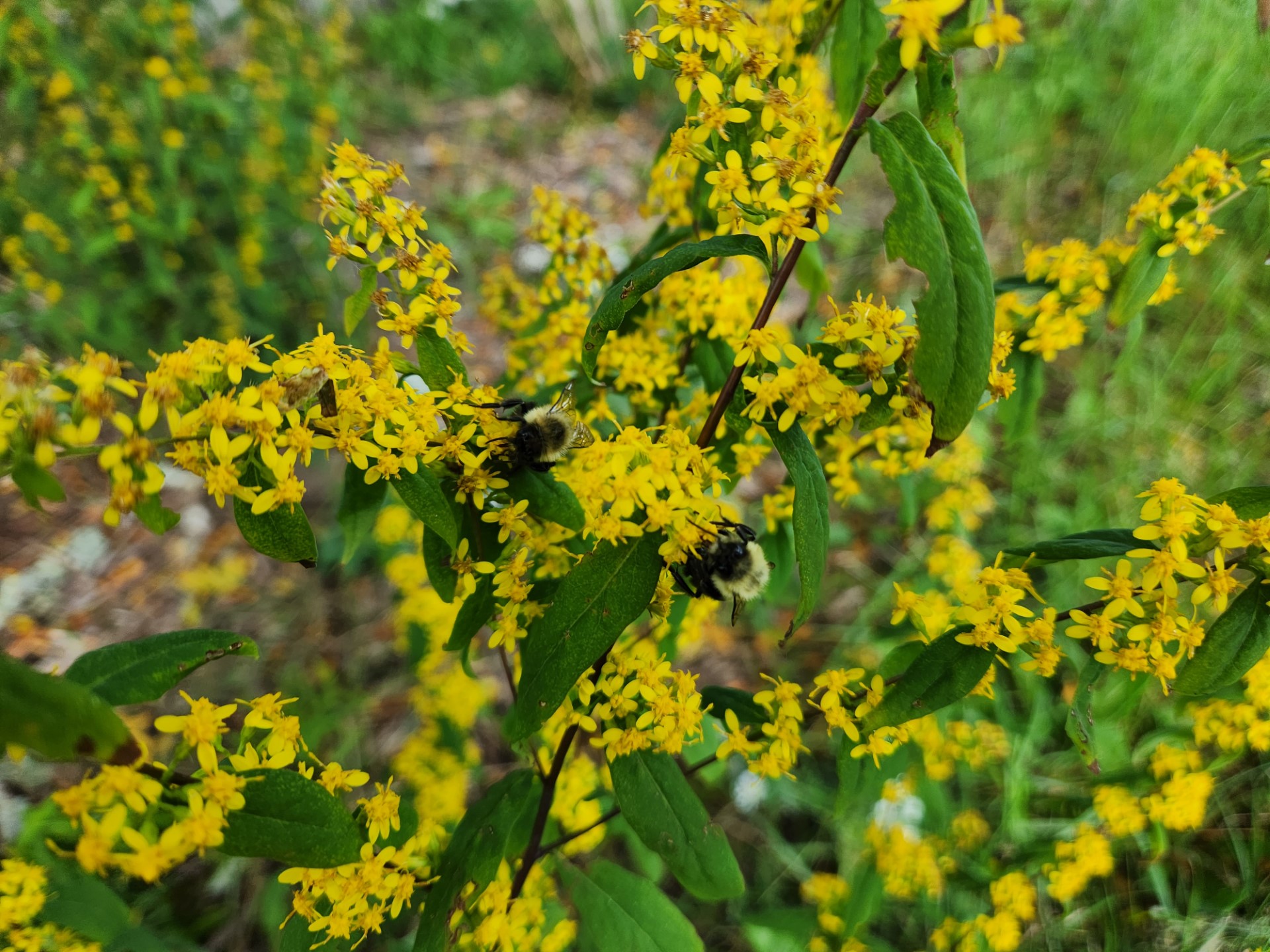
Bluestem Goldenrod
Solidago caesia |
|
|
|
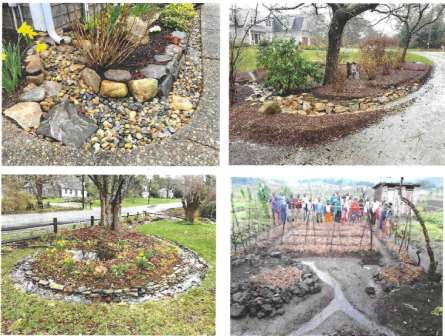
The Guidelines gives homeowners steps they can take in the design and maintenance of their properties that will support pollinators and birds, manage stormwater, conserve water, and protect the Cape's water quality. This 40-page booklet is beautifully illustrated by Marcy Ford with content that is easily digestible and supported by numerous resources for additional learning.
|
|
|
We are grateful for the several retail shops that are partnering with us to make this publication more widely available: Brewster Book Store, Birdwatchers General Store, Crocker Nurseries, Wellfleet Audubon Wildlife Sanctuary, Cape Abilities Farm, Cape Cod Museum of Natural History, the Cape Cod Lavender Farm, Heritage Museums and Gardens, Titcomb's Bookshop, Sea Howl Bookshop, Soares Flower Garden Nursery, and Eight Cousins Bookshop.
If you are a retailer and would like to sell this publication at your store, please contact us. |
|
|
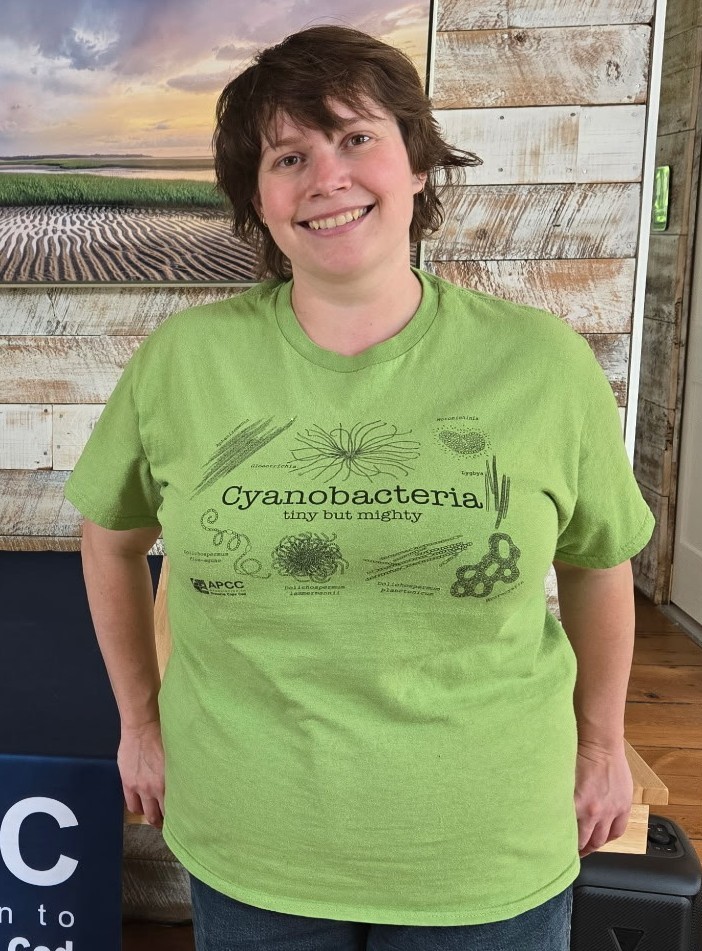
| Cyanobacteria ~ tiny but mighty
color kiwi $30 includes USPS shipping |
|
|
APCC caps
$25 -includes USPS deliver in the U.S. |
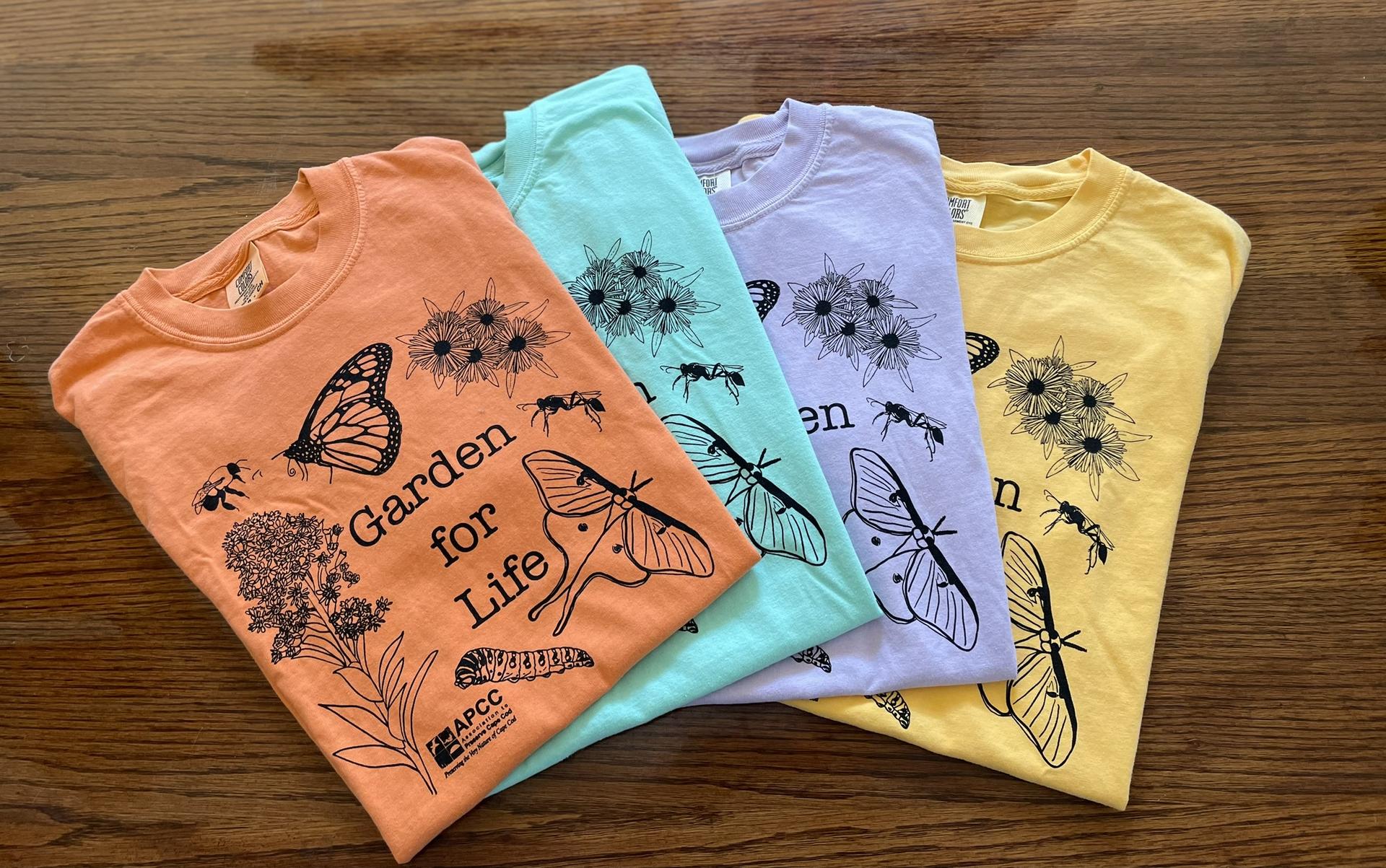
| Garden for Life T's $30 -includes USPS delivery in U.S. |
|
|
|
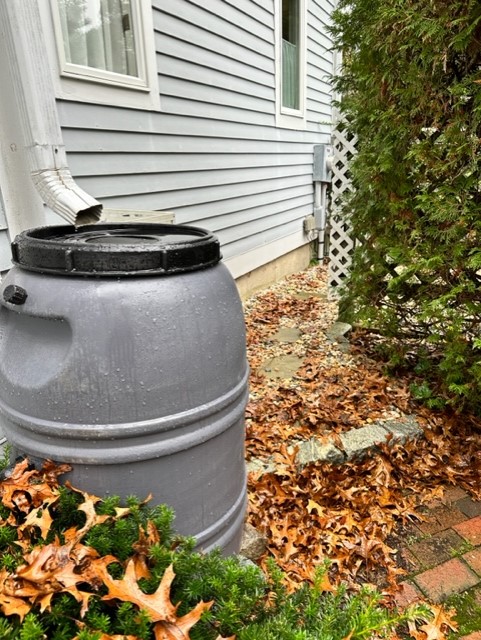
Rain Barrels for Cape Cod
Order online from Upcycle Products $122 each includes shipping to your door APCC receives a portion of the proceeds.
These are 55 gallon, repurposed food barrels. For more information, click here. |
|
|
| APCC eNewsletters.
Our weekly newsletters are archived on our website and easily shared.
You can find past newsletters and share with your friends. Encourage others to sign up for future enewsletters HERE.
|
|
|
Are you thinking of going solar? We hope so!
In partnership with E2 SOLAR in Dennis, APCC receives $500 for every solar installation when APCC is named as referral. |
|
|
|
Thank you to the homeowners who just contracted to install solar panels through E2 Solar. May the sun always shine for you! |
|
|
Expressions Gallery, 578 Main Street, Chatham
CLICK HERE |
Expressions Gallery donates 20 percent of its profits to APCC's work. |
|
|
Thank you to our business sponsors! |
|
|
APCC is rated four stars by Charity Navigator,
2024 Platinum by Candid (formerly Guidestar), and 2024 Top-Rated by GreatNonprofits. |
|
|
Our Contact Information
*{{Organization Name}}*
*{{Organization Address}}*
*{{Organization Phone}}*
*{{Organization Website}}*
*{{Unsubscribe}}* |
| |
|
|