Association to Preserve Cape Cod |
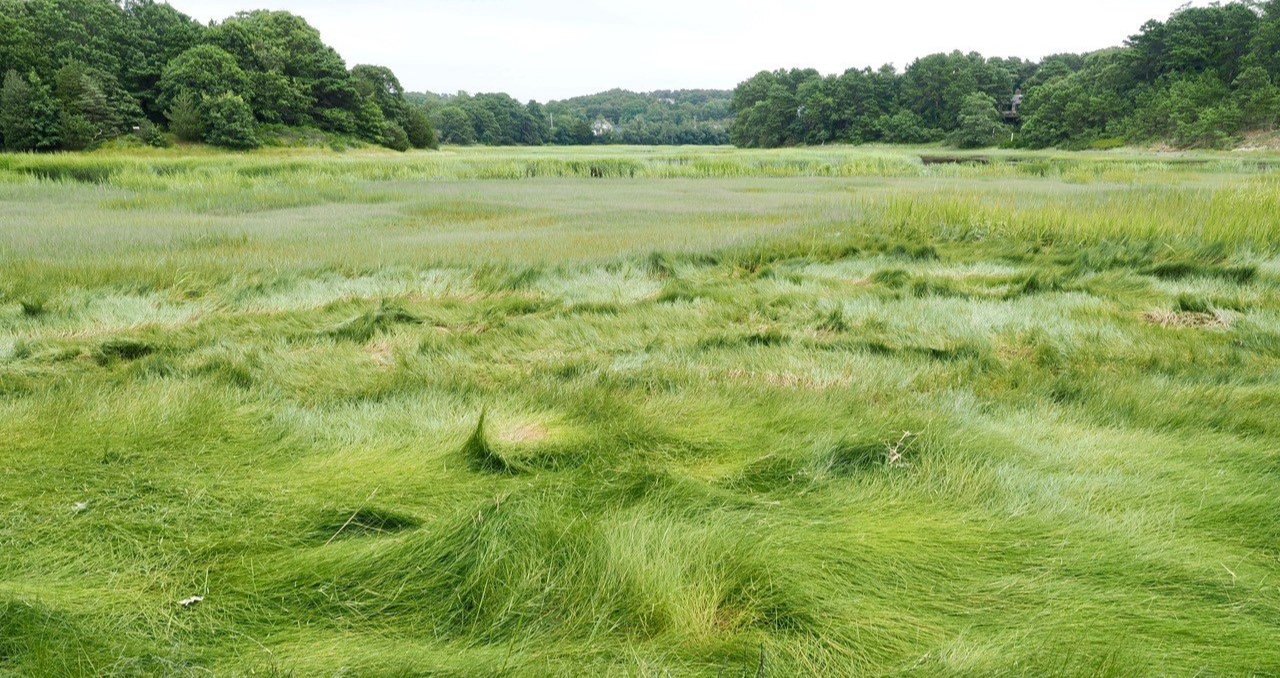
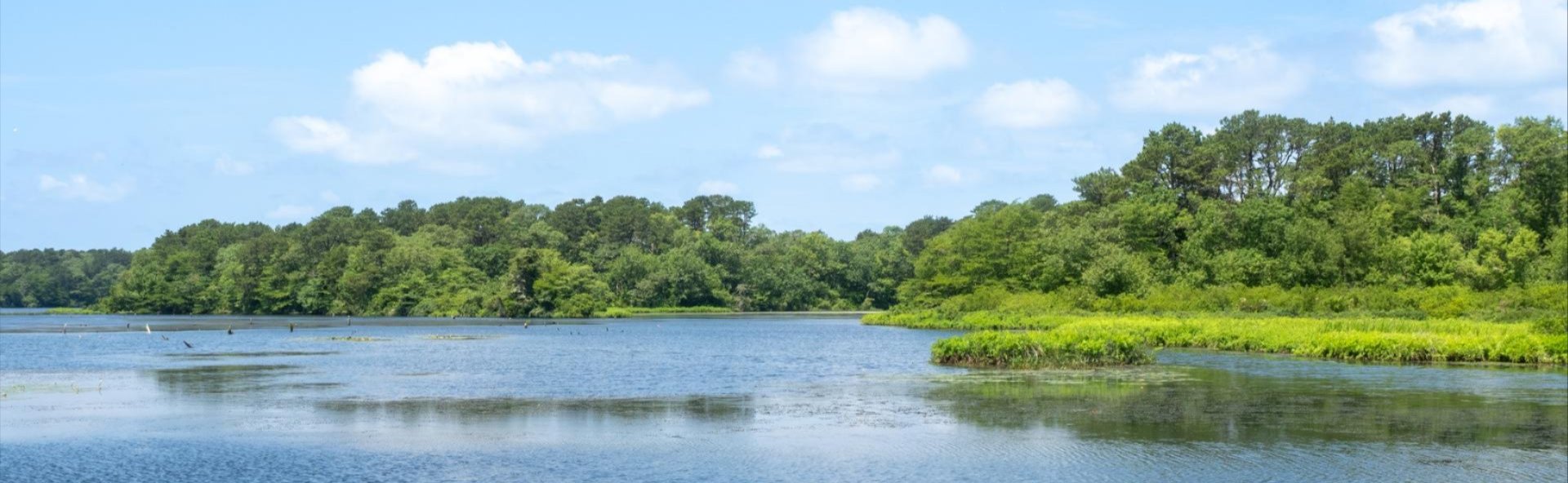
Above: Salt marsh in Wellfleet. Photo by Sue Machie |
|
|
APCC Weighs in on a Proposed State Environmental Bond Bill
Last week, APCC submitted written testimony to the State Legislature’s Joint Committee on Environment and Natural Resources regarding a five-year environmental bond bill, also known as the Mass Ready Act. The bill provides funding authorization for a variety of critical environmental programs and initiatives to protect land and water, as well as funding to improve the state’s climate resilience.
APCC’s comments included the following: -
Strong support for funding provisions that bolster the Clean Water State Revolving Fund, which will provide assistance to Cape Cod towns with their wastewater management projects.
-
Support for grant eligibility expansion of the state’s Municipal Vulnerability Preparedness Program to include nonprofit organizations, which will help expand climate readiness projects across the Commonwealth.
-
Recommendations to replace language in the bill directed at streamlining the permitting process for wetland restoration projects with the language found in An Act Accelerating Wetlands Restoration (H.1052/S.557), which provides a more comprehensive and thought-out approach to fast-tracking beneficial wetland restoration efforts.
-
Strong concern about language in the bill that would streamline the permitting process for “priority housing” projects located within Wetland Protection Act jurisdiction, including wetland buffers and floodplains. The proposed language would eliminate public hearings and opportunities for the public to comment on housing projects in those locations and limit the ability of community members to appeal decisions on project proposals.
- Support provisions to streamline culvert replacement projects.
- Recommendations to include language found in An Act Relative to Maintaining Adequate Water Supplies Through Effective Drought Management (S.586/H.1003), which provides the state with the ability to more effectively manage water use during drought situations.
-
Recommendations to include the language of An Act Restricting the Use of Rodenticides in the Environment (H.965/S.644), which would phase out the use of second-generation anticoagulant rodenticides (SGARs).
- Recommendations to include language that provides more local regulatory control of fertilizer use on Cape Cod to protect water resources.
The bill must be vetted and released from the committee and then must be passed by both the House and Senate before it can be signed into law by the governor. |
Ecosystem Restoration Program |
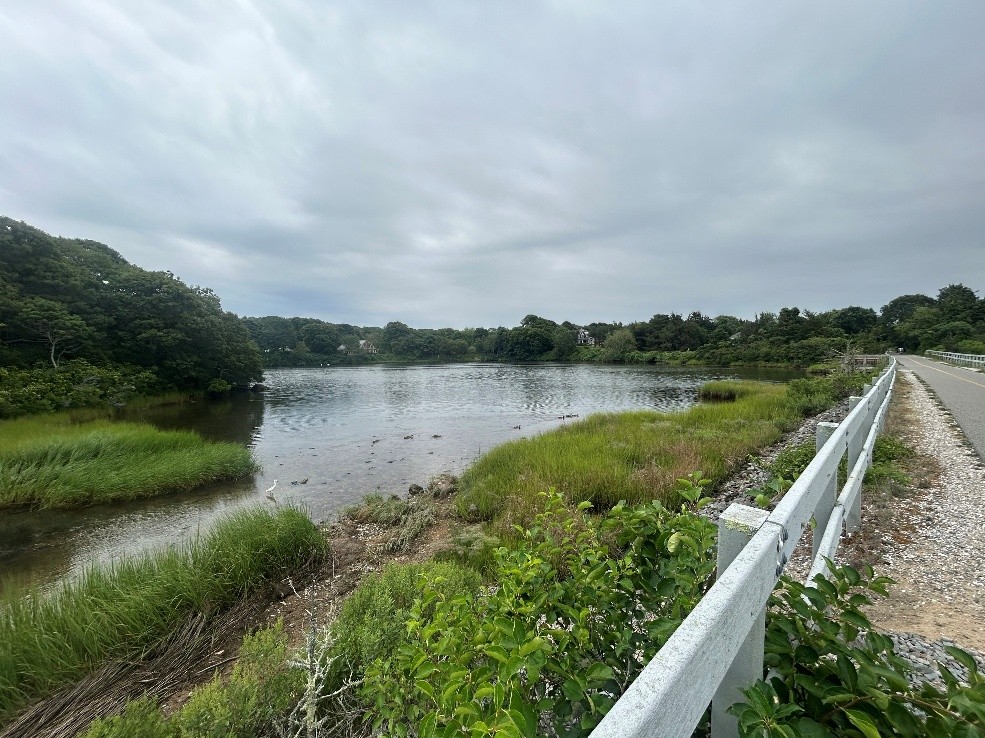
Above: Oyster Pond looking south along the Shining Sea Bikeway in Falmouth |
Recap of the Oyster Pond Restoration Project Public Meeting
On July 16th, APCC, in partnership with the town of Falmouth and other collaborators, hosted a public meeting at the Falmouth Public Library to share updates on the Oyster Pond (West Falmouth Harbor) Restoration Project. The project aims to replace an undersized culvert beneath the Shining Sea Bikeway to restore tidal flow, enhance three acres of salt marsh habitat, and improve water quality in the seven-acre pond.
Presenters included Josh Wrigley, town of Falmouth coastal resilience specialist, Patrick Temple, salt marsh project manager for the Cape Cod Conservation District, Nils Wiberg, chief water resources engineer for Fuss & O’Neill, Mitchell Buck, coastal engineer for the Woods Hole Group, and Jordan Mora, APCC lead ecologist & science advisor. The team outlined restoration goals, shared findings from hydrodynamic modeling and ecological monitoring, and presented permit-ready culvert replacement designs.
Community feedback gathered during the meeting will inform the next phase of the project as it moves toward permitting. While additional grant funding is being pursued for implementation, the project team remains focused on effective communication and minimizing impacts related to the required Shining Sea Bikeway detour during construction. The project is funded by the Cape Cod Conservation District through the USDA NRCS Cape Cod Water Resources Restoration Project and the 2024 NOAA Transformational Habitat Award.
Read more in The Enterprise article published July 17, 2025. For more information, visit the Oyster Pond project webpage.
|
YOU’RE INVITED!
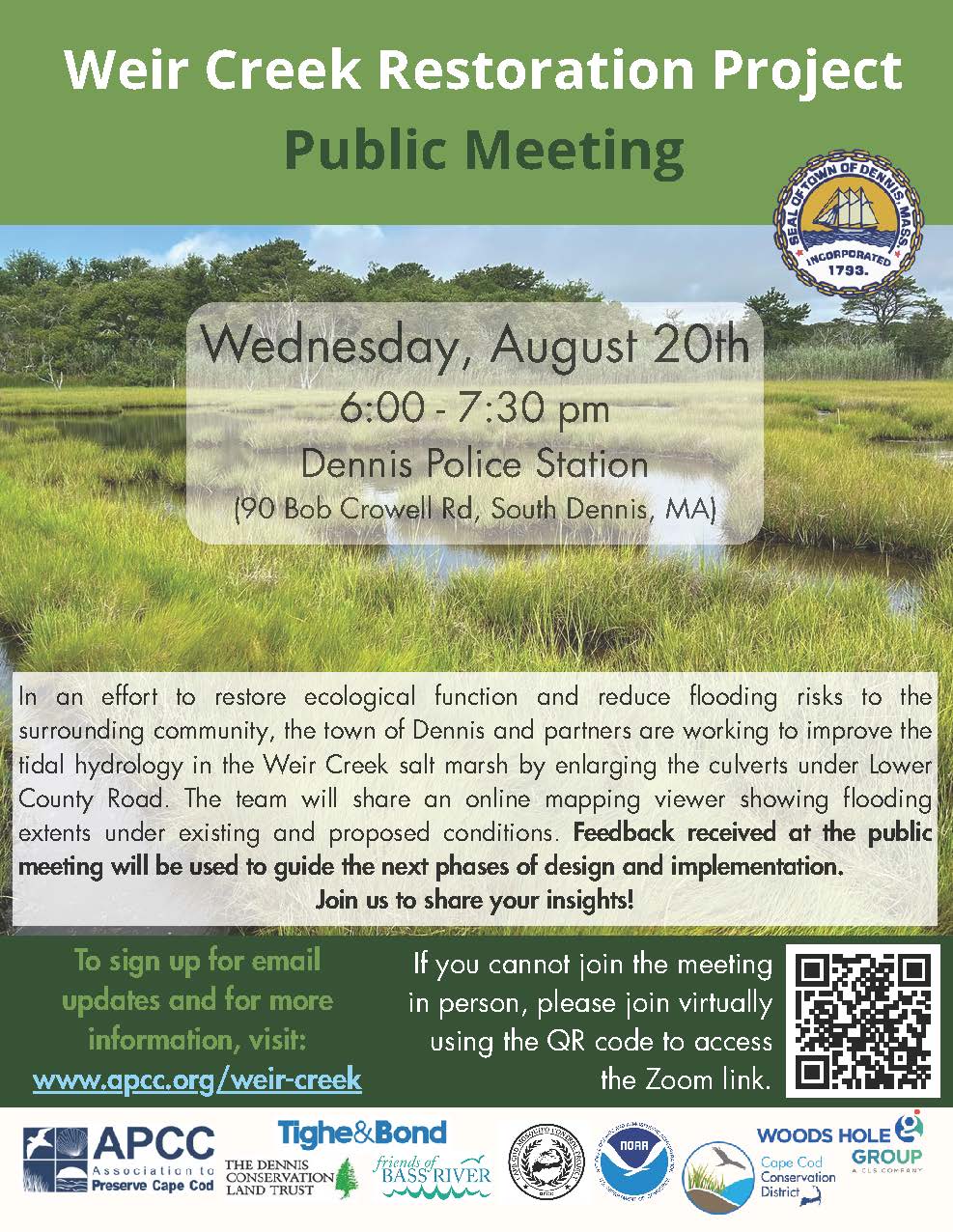
A Public Meeting for the Weir Creek Restoration Project
In coordination with the town of Dennis and project partners, APCC invites you to the Weir Creek Restoration Project Public Meeting on August 20th, 2025, from 6:00 p.m. to 7:30 p.m. in the Community Room at the Police Department Office, 90 Bob Crowell Road, South Dennis.
This project is supported by a National Oceanic and Atmospheric Administration (NOAA) Transformational Habitat Grant, the Cape Cod Conservation District, and private foundation funding. APCC is providing grant administration and technical support, working closely with the town of Dennis, the Cape Cod Conservation District, Tighe & Bond, Woods Hole Group, the NOAA Restoration Center, Dennis Conservation Land Trust, Friends of Bass River, Cape Cod Commission, Cape Cod Mosquito Control Project, and the U.S. Department of Agriculture’s Natural Resource Conservation Service.
For more information and to sign up for the project email list, please visit the Weir Creek Tidal Restoration webpage.
For questions, please contact Jordan Mora, lead ecologist at APCC. |
|
|
APCC's Pond Programs <º/,}}}}}}}=<{ <º/,}}}}}}}=<{ |
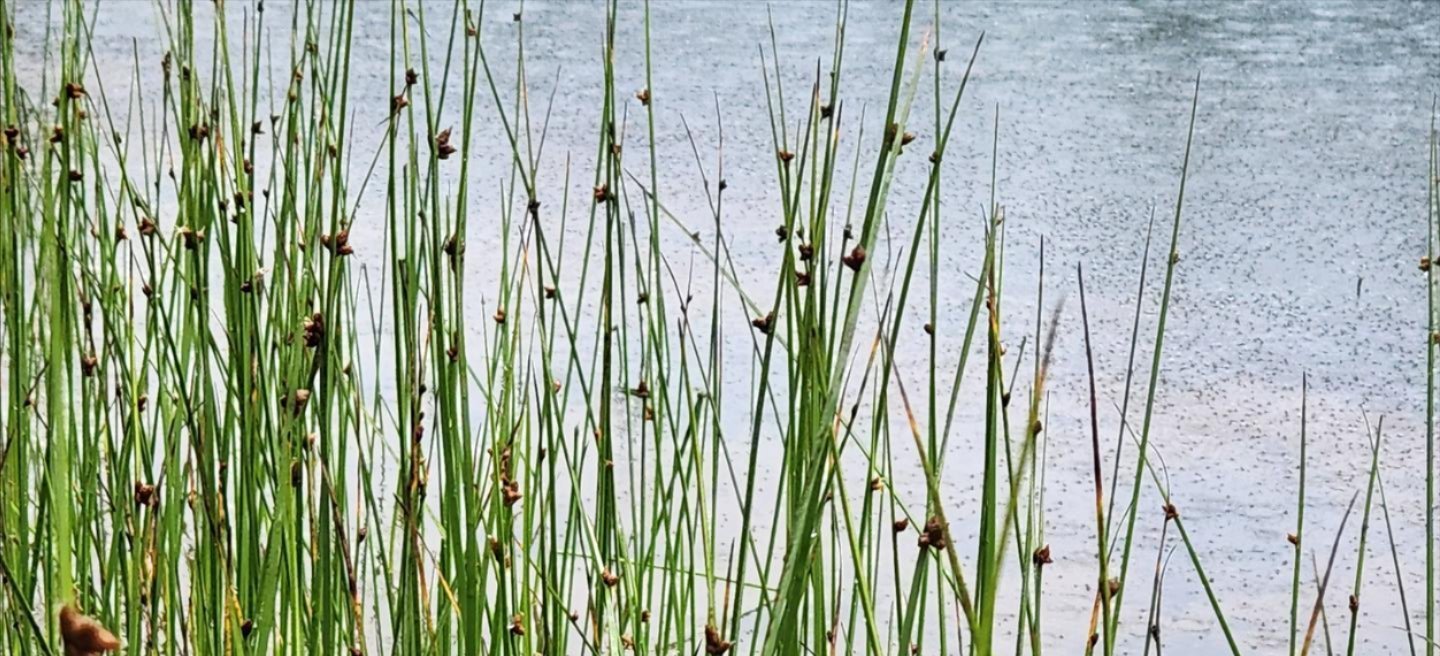
Our summer interns encounter all sorts of interesting pond life under the microscope as they conduct the microscopy that identifies the cyanobacteria found in the program's water samples. Each week, you'll find an article on their findings here. |
|
|
Cape Cod’s Cows of the Sea |
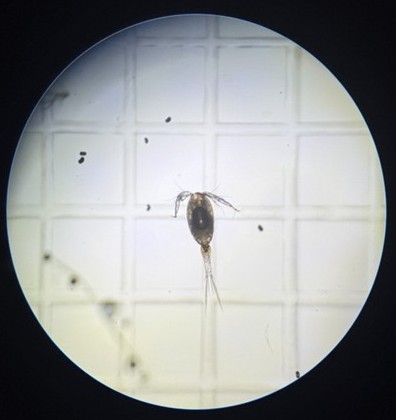
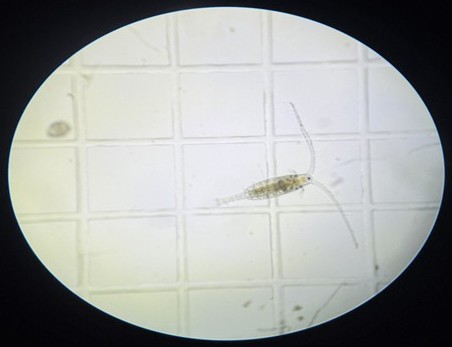
Manatees may be the first creatures you think of when you hear the phrase “cows of the sea.” Think again. Copepods are also known as “cows of the sea,” and, unlike manatees, these teeny-tiny crustaceans live free and in the wild in both marine and freshwater habitats all across the Cape.
Why the cow comparison? Well, a main reason is that just as cows graze on grass, copepods graze on phytoplankton and convert the sun's energy into food for high trophic levels in the food web. And, boy, do copepods eat! In fact, a single copepod can eat between 11,000 and 373,000 diatoms (a type of phytoplankton) in 24 hours! To do so, the clever crustaceans use their antennae to create water currents that then deliver the food right to their mouths. Copepods aren’t fussy and will happily devour a wide variety of phytoplankton and other small zooplankton, even the daphnia we talked about in a recent newsletter.
Calanoida, Cyclopoida, Harpacticoida are the three orders that dominate the copepod population in freshwater environments. They, like their saltwater “siblings,” are incredibly fast swimmers—some are capable of traveling 295 feet in an hour. To put that in perspective, that's the human equivalent of swimming 50 miles per hour! That being said, many fish love to make a meal out of tasty copepods, and, well, they are bigger and pretty darn fast themselves.
Many species of copepods store a significant amount of lipids (fats) in their bodies to help with buoyancy and for food supplies when conditions are poor. When copepods are eaten by fish, such as river herring, they absorb these fats, which is a reason why herring are rich in essential heart-healthy fatty acids like omega-3s.
Copepods reproduce sexually and their life cycle starts with an egg. Some species carry their eggs with them in egg sacs, while others release fertilized eggs directly into the water. After the egg stage comes a nauplius larva, which looks like a tiny spider. The nauplius larva eats plankton, sheds its skin six times and turns into an immature copepod, a.k.a., a copepodite. And then, after the copepodite sheds five more times, a bouncing baby “cow of the sea” is born.
|
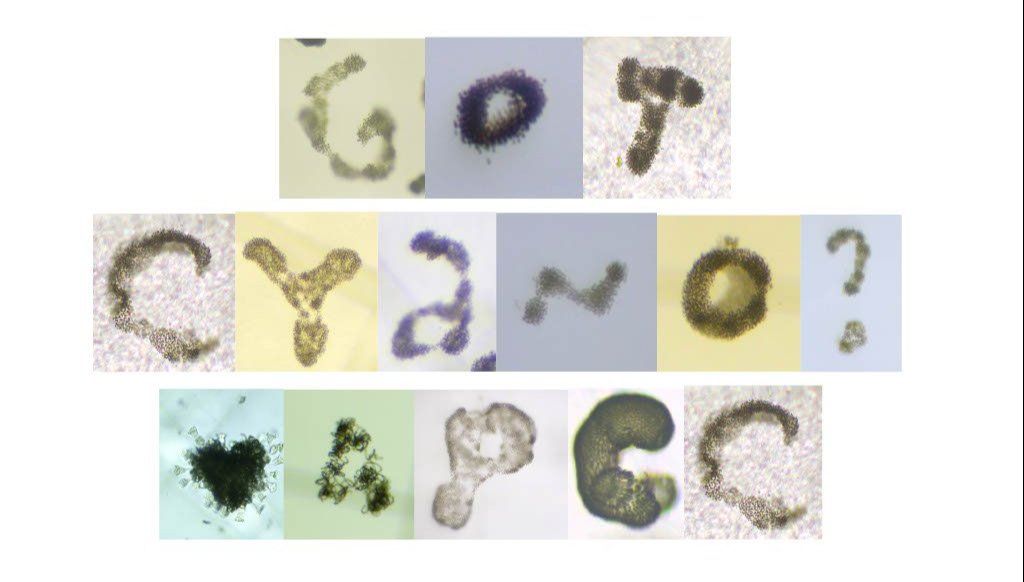
A special offering this week! The interns put this together for you—assembled from microscopy photos! |
|
|
Next meeting of the
Cape Cod Ponds Network Thursday, August 14, 6:00 - 8:00 p.m. in person at the Cape Cod Museum of Natural History, Brewster All are welcome. |
|
|
Cape Cod Pond Watchers Bio-survey Program ~ a training video on how to use the Survey123 app to log your observations in pondside! |
| |
|
APCC's Cyanobacteria Monitoring Program |
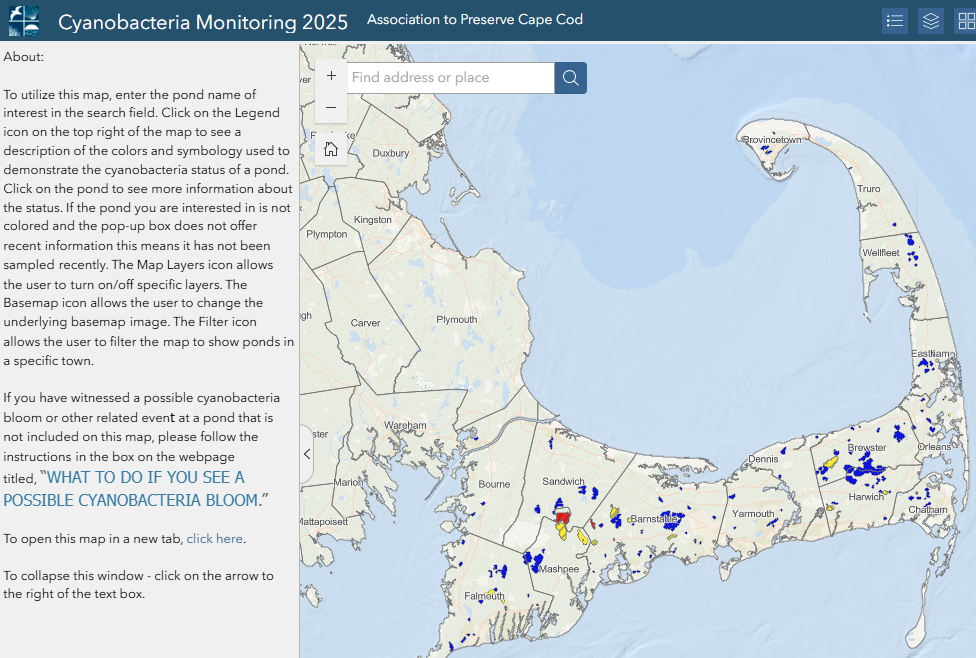
"When in doubt, stay out." High concentrations of potentially toxic cyanobacteria were detected in several ponds last week, at levels that are of concern for pets and children who are more susceptible due to ingestion. |
Check on the status of your favorite pond on our interactive map. If you see what appears to be a bloom, take a picture, note the day, location, and time and notify the local health department, and email to cyano@apcc.org.
Sign up for cyanobacteria email alerts.
Please note: The cyanobacteria alert is only sent out when a concern is first identified at a pond. All updates following this initial notice are shared on APCC’s interactive map. |
Around the Grounds at APCC Headquarters |
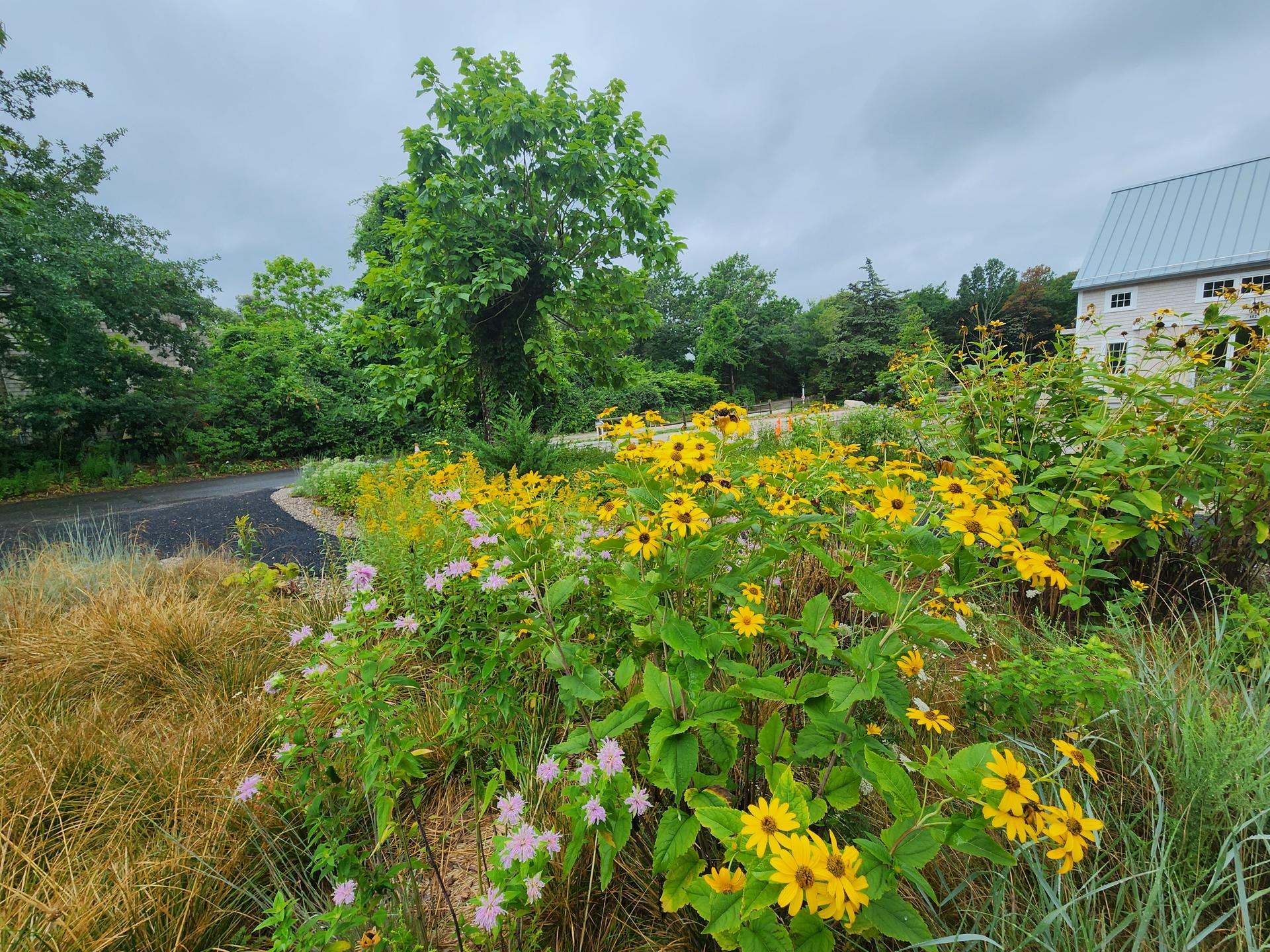
Above: Catalpa resprouted. |
|
|
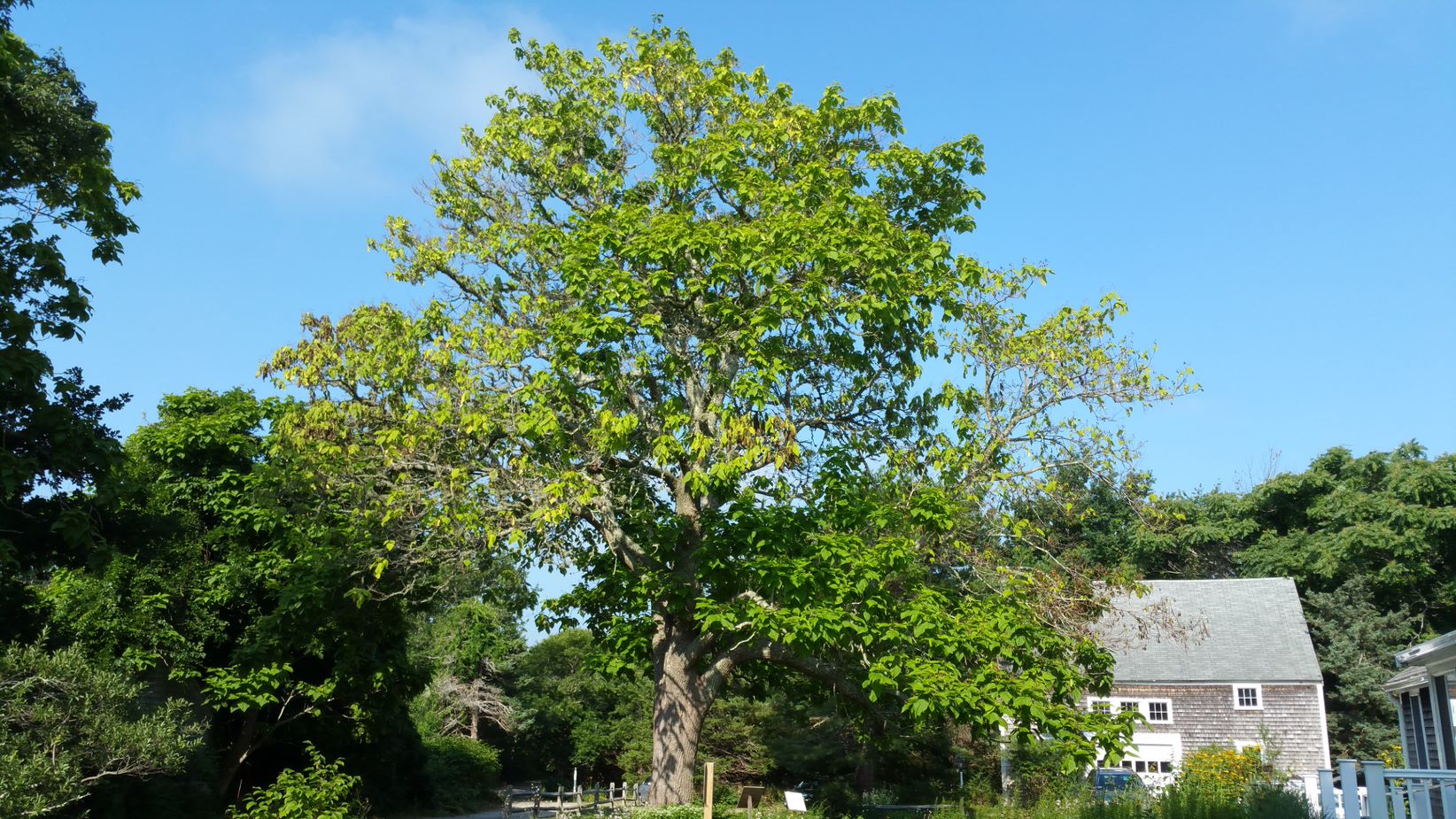
Above: Catalpa in poor health. |
|
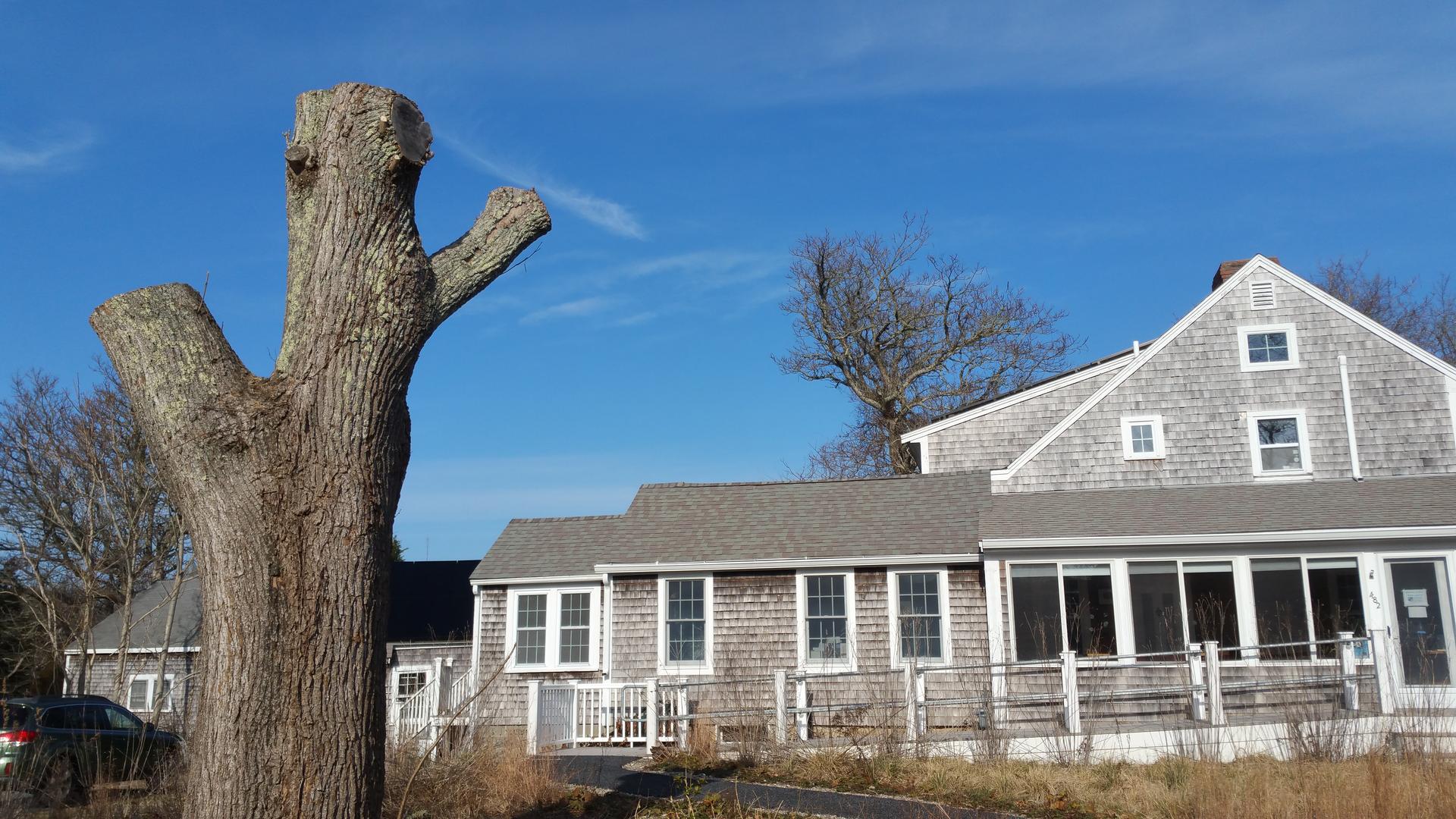
Above: After removal of branches. |
|
|
Noticing this year that our beloved old catalpa tree has been filling out after we had to take extreme safety measures and cut down its massive canopy that was dead from wilt. We purposefully left the trunk for wildlife and to retain the carbon in place, and like catalpas and other trees, including oaks, cherry, red maple, can do, it has resprouted and once again is offering some shade.
If there's a message here, it's asking you to also reconsider tree removal--instead, "coat hanger" the tree, leave the trunk to a safe height. Put up with its convalescence and let it come back to life and support wildlife. And even if not a species that will resprout, the trunk will provide valuable wildlife habitat. |
|
|
|
New Addition—A Rain Gauge! |
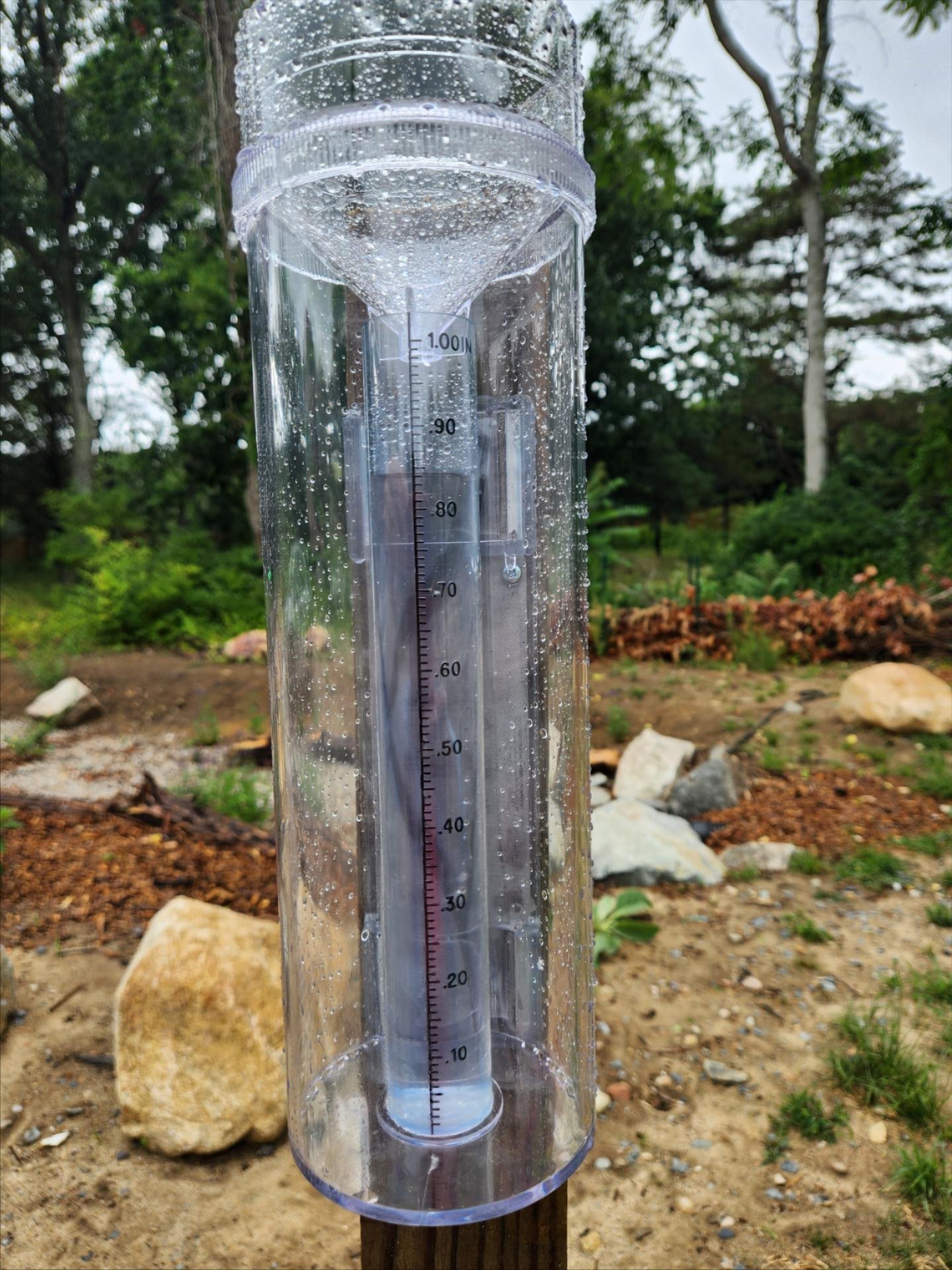
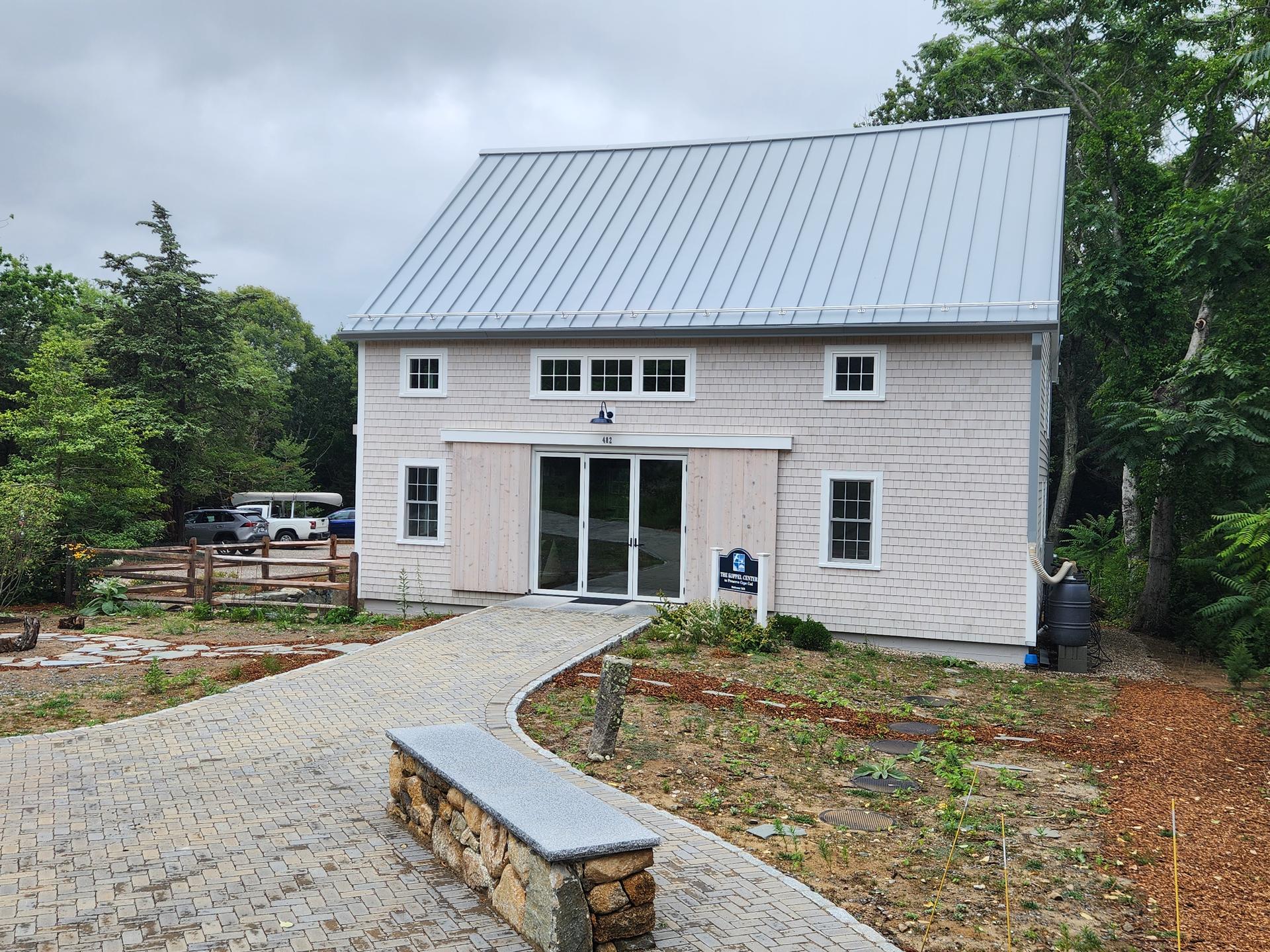
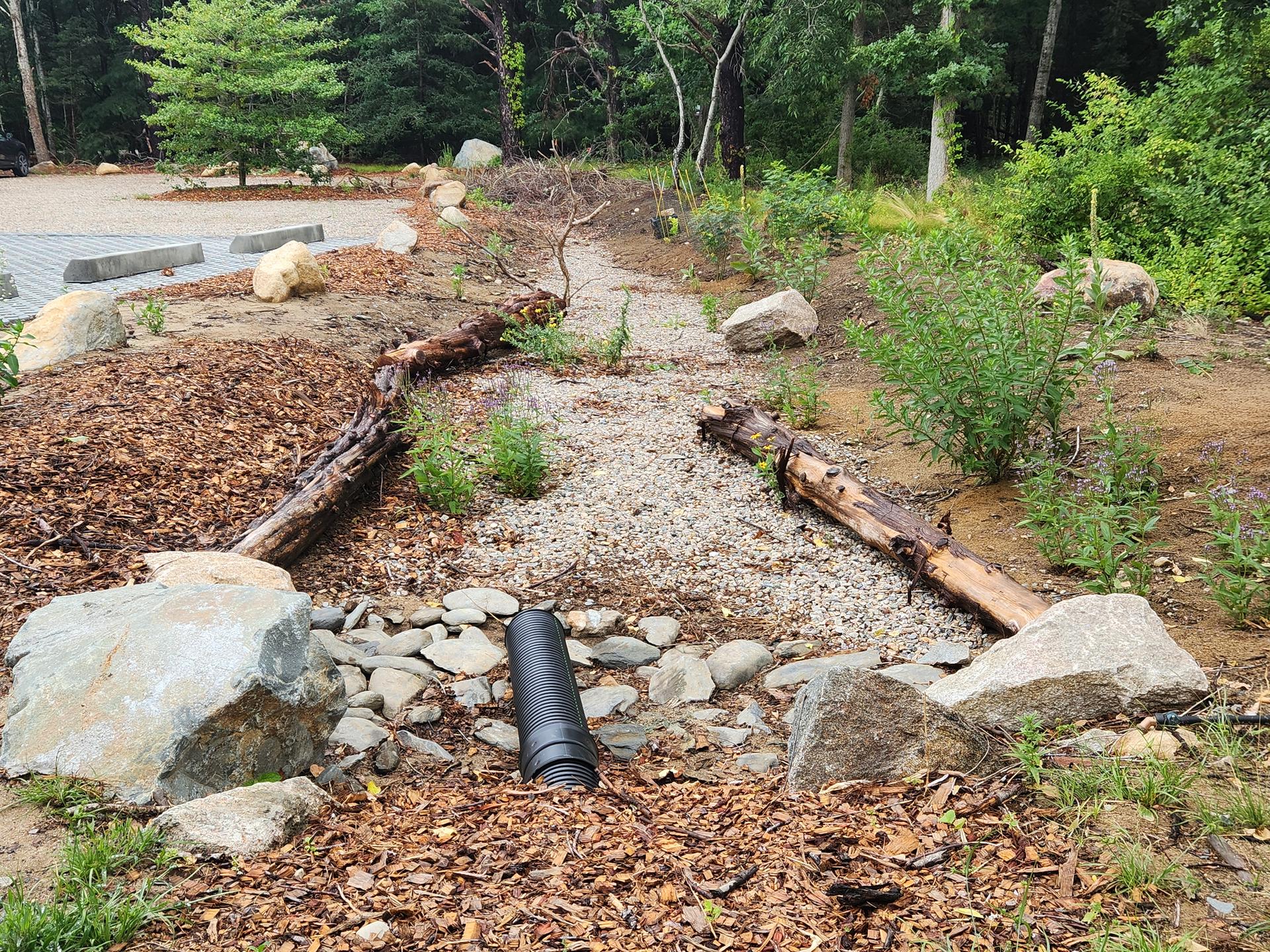
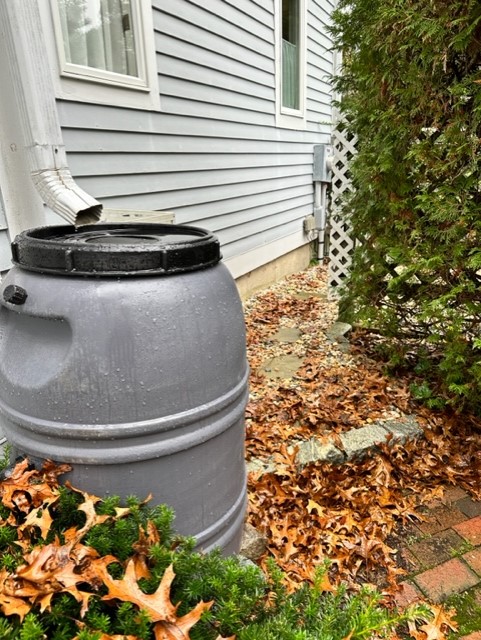
We were able to measure the day of rain we experienced recently with our new rain gauge. A little over eight tenths of an inch fell on August 1. Better than nothing, but our landscape, like all of Cape Cod, needs more. The gauge is installed on a post next to the rain garden behind the Koppel Center—this is the rain garden that receives all of the roof runoff from the Koppel Center.
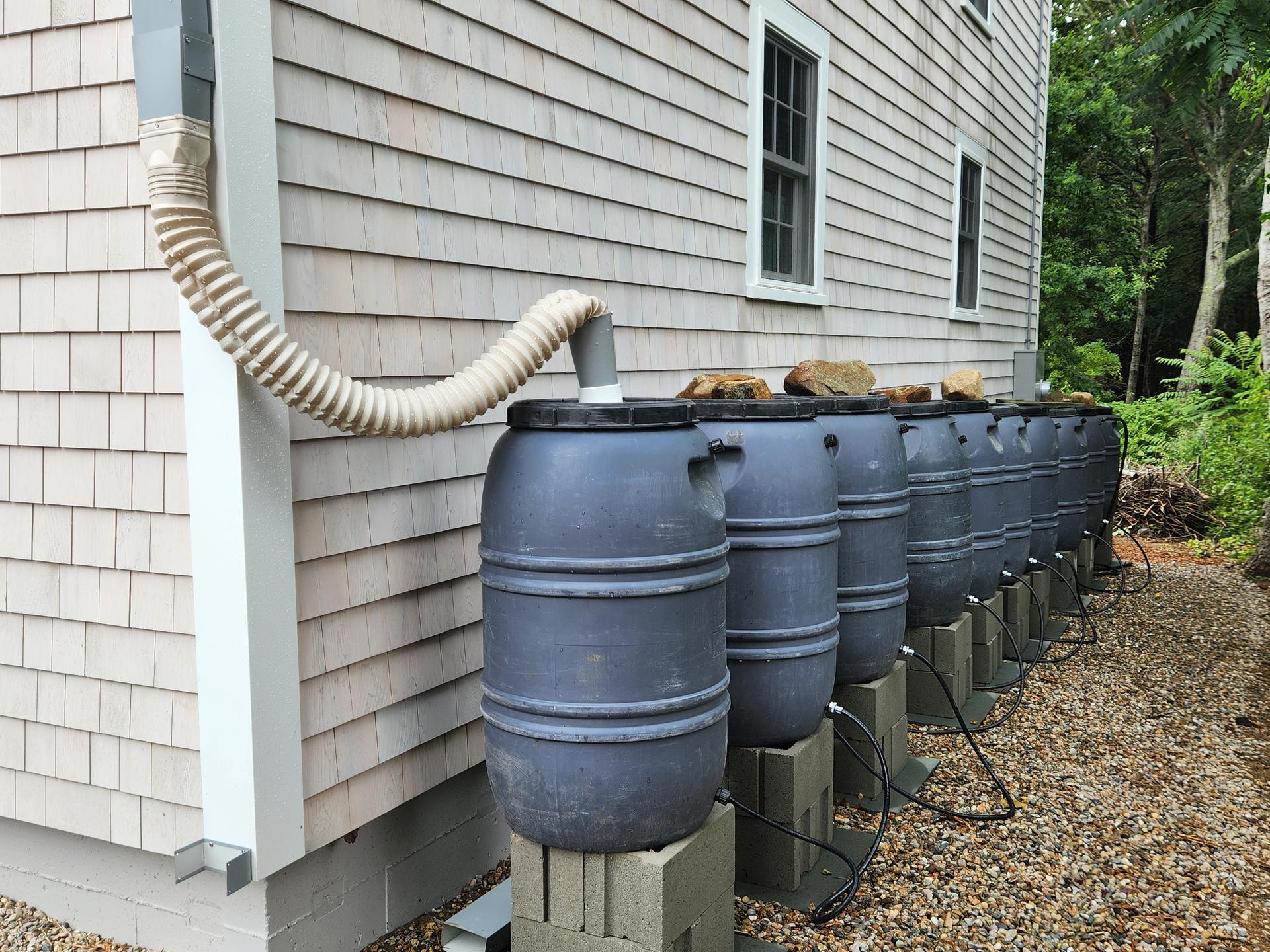
The stormwater coming off of the Koppel Center metal roof is cleaner than from an asphalt roof. We collect half of what falls on the roof in rain barrels—when they are full, the overflow is directed to the rain garden. |
|
|
We calculated that in a significant rainstorm—say 3.5 inches, our roof would be shedding 2,363.5 gallons and ultimately captured by the rain garden and the rain barrels. Half of that would be directed to the rain garden and the other half is captured by our 10 rain barrels, that have a total of 550 gallon storage capacity. The overflow from the rain barrels is directed into the rain garden. A one inch rainstorm, a bit more than we had this morning, will shed about 675 gallons. We can't wait for the next rain storm! |
Above: Rain garden under development |
Support Birds
According to a 2019 report in the journal of Science, we have lost 2.9 billion (that’s a “B”) breeding birds in North America since 1970. That means for most of us, during our lifetime, bird populations have dropped by almost 30 percent. One billion of the birds are those species that depend on forests. Grassland species have been the hardest hit with 73 percent of grassland bird species in decline. Not surprisingly, migratory bird species fared far worse than resident birds species. Wetland birds were the only group that appeared to have a slight increase, presumably due to our conservation efforts for the past many decades in protecting their wetland habitats.
“Losses among habitat generalists and even introduced species indicate that declining species are not replaced by species that fare well in human-altered landscapes.”
The significant decline of birds is attributed to loss of habitat from development and industrial agriculture, also linked to the decline in insect species and the size of insect populations—bird food. Coastal disturbance, mortality due to direct human causes (use of rodenticides and insecticides, window collisions, predation by pets, etc.), and the wild card of climate change with more intense weather events, rising seas and loss of coastal habitats.
Here are some things that you can do to help our birds: -
Keep cats indoors. The American Bird Conservancy says that in the United States alone, outdoor cats kill over one billion birds every year.
-
Make windows safer for birds. They perceive reflections in glass as a habitat they can fly into. Experts recommend installing screens or using film/paint/cords to break up reflections. All About Birds has several examples. At APCC's headquarters, we have installed Acopian BirdSavers, a.k.a. Zen wind curtain cords, on windows of the Koppel Center.
- Grow native plants that support birds with food: fruit, seeds, and insects.
- Avoid pesticide use, including rodenticides, insecticides, and fungicides.
-
Preserve standing dead trees that provide an insect food source and sometimes a nesting site for cavity dwelling birds, such as screech owls, flickers, and woodpeckers.
-
Reduce your contribution to light pollution. Lighting should be directed downward, or better yet, go dark—especially during migration. Going dark is good for lots of critters, including your neighbors.
The economic value of birds has always been important. Their contribution to our enjoyment of the natural world—priceless for many of us. Their role in ensuring that ecosystems continue to function is crucial. Let’s do what we can to support our birds. |
|
|
Botanize a bit with Erin Camire, APCC's ecolandscape program coordinator, in the video below. A short clip from a walk at Forest Beach in Chatham. |
|
|
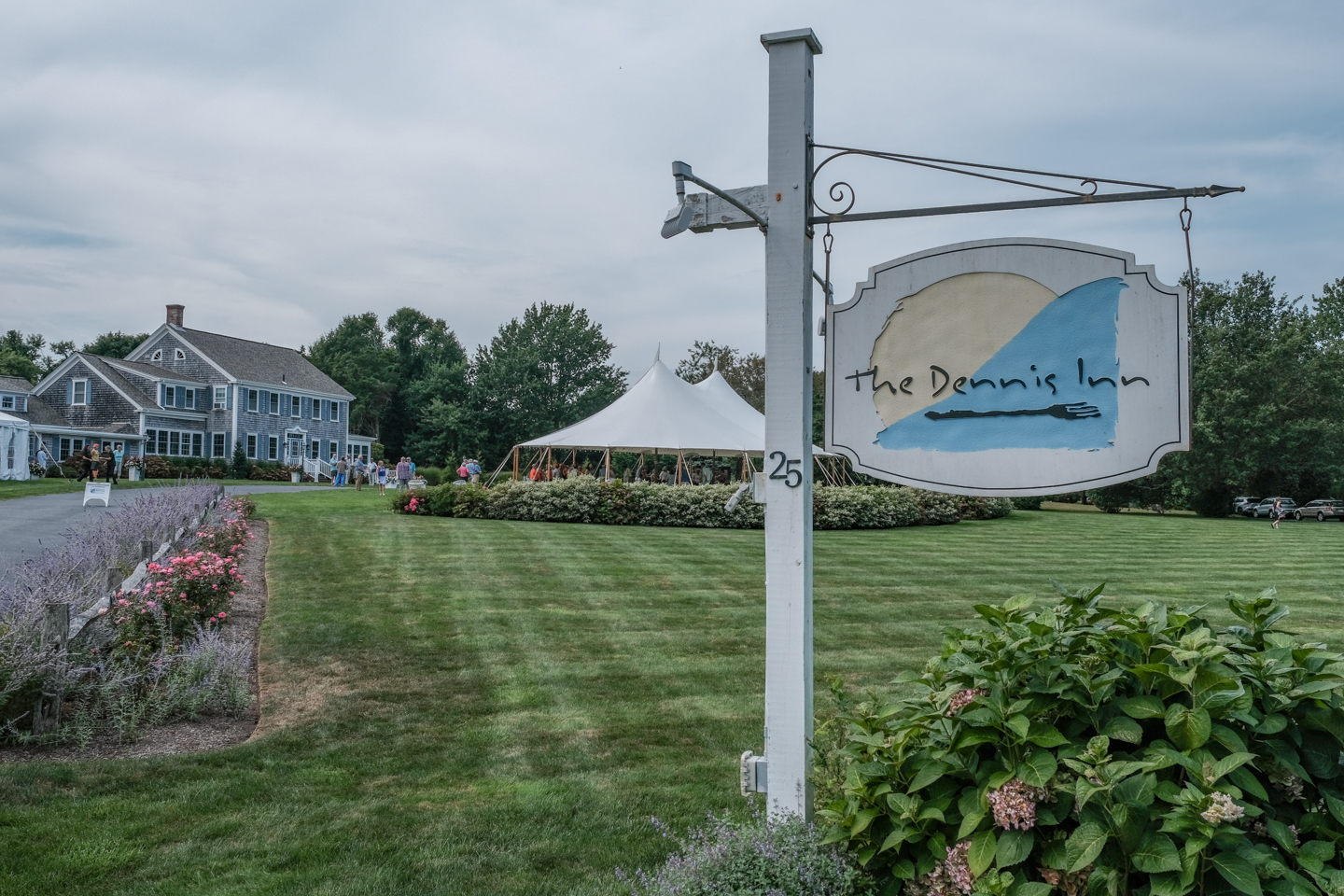
| SAVE THE DATE! APCC's Annual Meeting ~ Sunday, September 14th at 12:00 p.m.
at the Dennis Inn |
|
|
| BPC's Annual Meeting Saturday, August 9th 8:30 - 11:00 a.m. Cape Cod Bible Alliance Church, Brewster Keynote speaker, Julie Hambrook Berkman, PhD, APCC's pond and cyanobacteria program manager.
REGISTER |
|
|
A Cape-wide Conservation Event Calendar |
|
|
The Compact of Cape Cod Conservation Trusts (“the Compact”) and its nonprofit members launched a new regional calendar of events. The Conservation Calendar includes programs across Cape Cod hosted by these groups. The goal of the calendar is to encourage visitors and residents to take part in nature and environmental events. You can always find the link to the calendar on APCC's website under News & Events.
|
If you are a farmer or someone who wants to grow native plants to sell, or just want to be updated on the program's development, please submit an interest form that appears on our webpage. We will be sending periodic email notices of workshops and meetings.
Funding for the project is provided by Barnstable County and its Economic Development Council License Plate Grant Program through the Cape Cod Commission. |
|
|
A Cape Cod Native Plant-selector
~ to help you choose the perfect native plants for your garden. |
|
|
Email kandres@apcc.org and we'll send you a CapeCodNativePlants.org decal. |
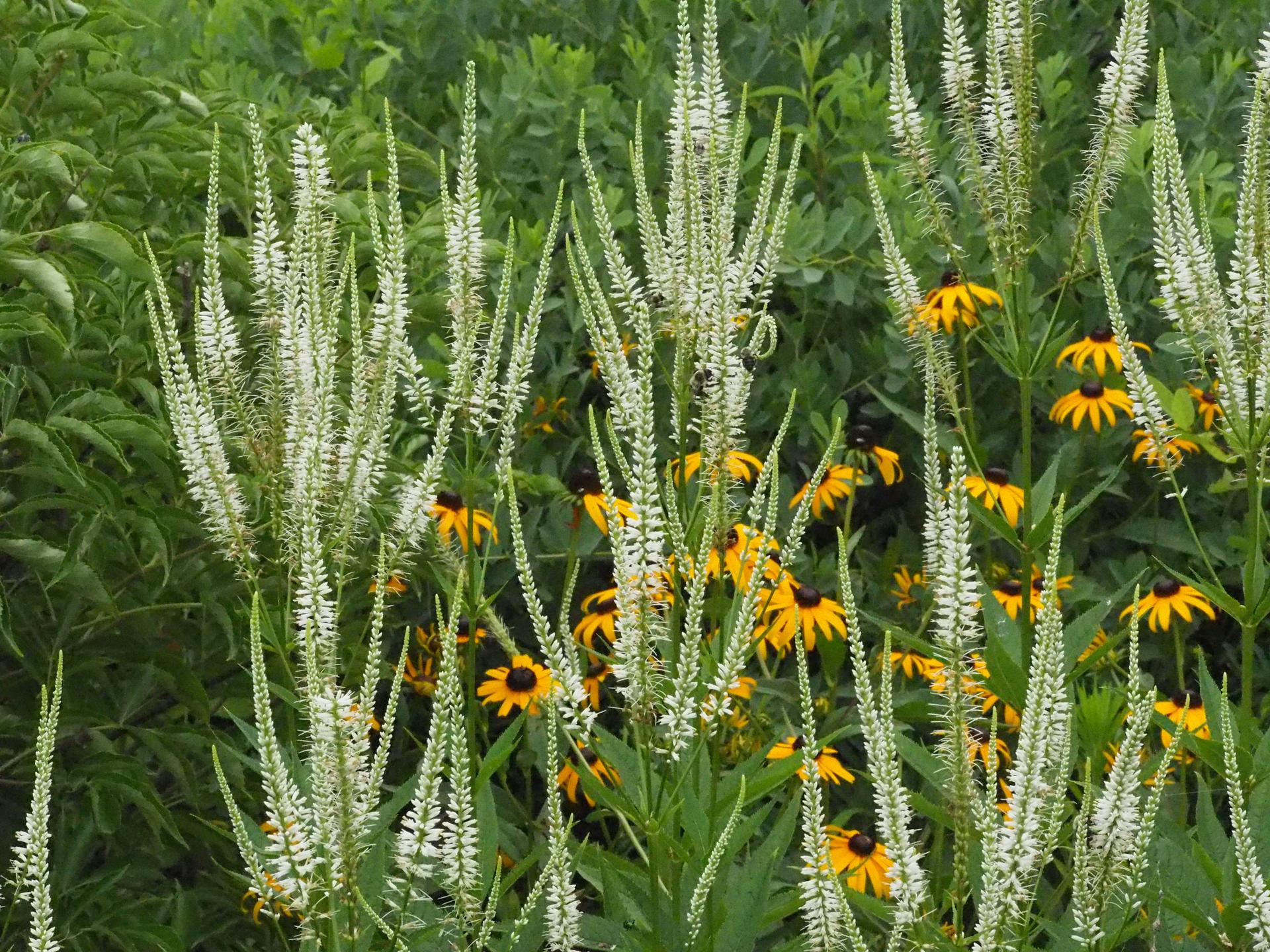
| Culver's Root Veronicastrum virginicum |
|
|
The Guidelines gives homeowners steps they can take in the design and maintenance of their properties that will support pollinators and birds, manage stormwater, conserve water, and protect the Cape's water quality. This 40-page booklet is beautifully illustrated by Marcy Ford with content that is easily digestible and supported by numerous resources for additional learning.
|
We are grateful for the several retail shops that are partnering with us to make this publication more widely available: Brewster Book Store, Birdwatchers General Store, Crocker Nurseries, Wellfleet Audubon Wildlife Sanctuary, Cape Abilities Farm, Cape Cod Museum of Natural History, the Cape Cod Lavender Farm, Heritage Museums and Gardens, Titcomb's Bookshop, Sea Howl Bookshop, Soares Flower Garden Nursery, and Eight Cousins Bookshop.
If you are a retailer and would like to sell this publication at your store, please contact us. |
|
|
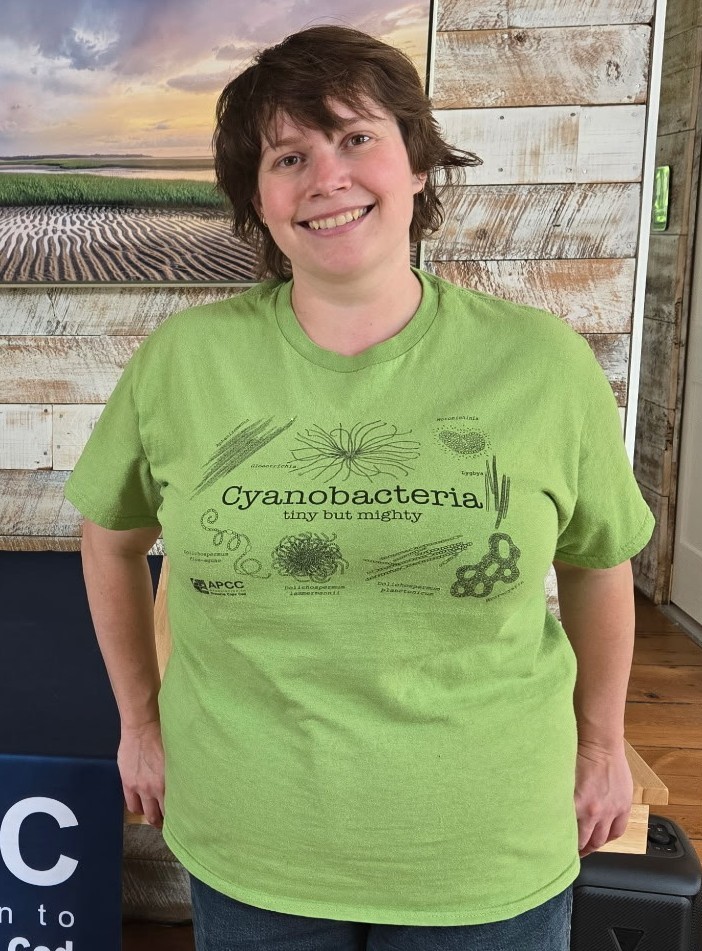
| NEW! T's
Cyanobacteria ~ tiny but mighty color kiwi $30 includes USPS shipping |
|
|
APCC caps $25 -includes USPS deliver in the U.S. |
|
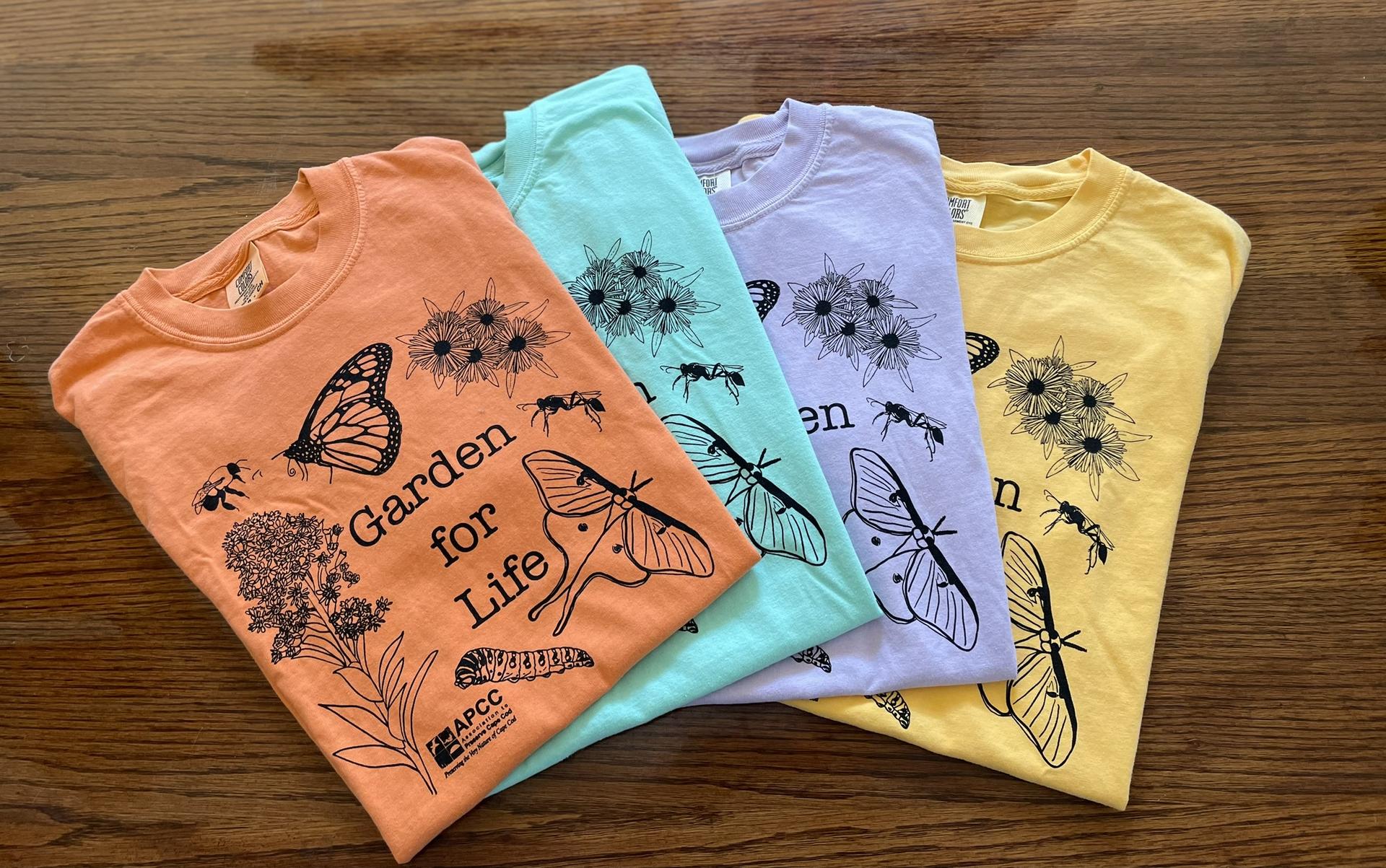
Garden for Life T's
$30 -includes USPS delivery in U.S. |
|
|
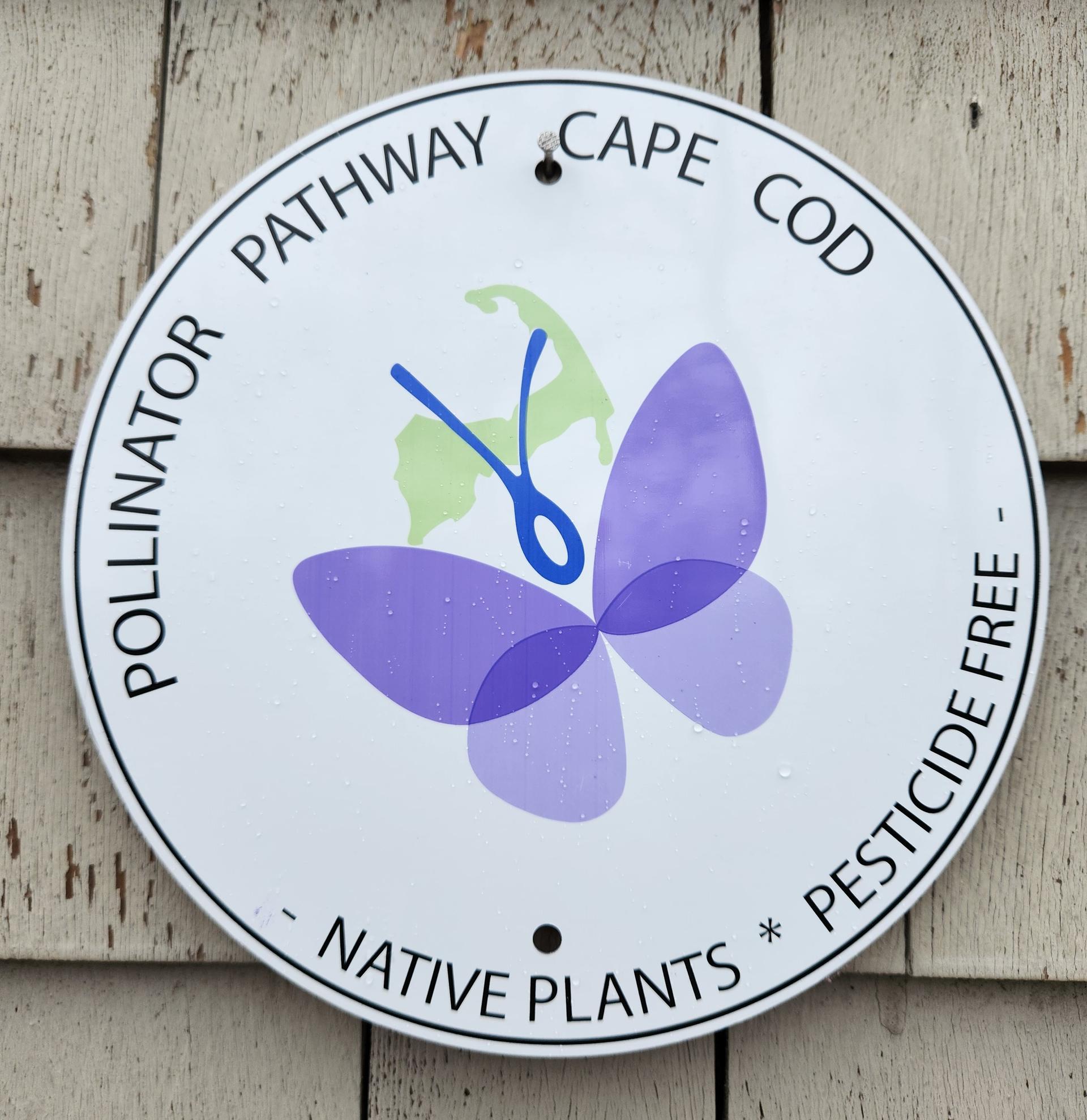
The Pollinator Pathway Cape Cod is a group of organizations promoting native plants and pollinator-friendly land care practices to create a boat load of safe oases for our native bees, butterflies and a whole host of other pollinators that are crucial to the health of our ecosystems.
Join us! It's easy. There are no fees. You just need to pledge to ADD native plants, SUBTRACT a little lawn, AVOID yard chemicals, especially pesticides, and LEAVE the leaves. And, help us spread the word. Please get on the map to show your support of pollinators on Cape Cod!
You can purchase the 9-inch aluminum Pollinator Pathway Cape Cod sign at Hyannis Country Garden, Crocker Nurseries, Brewster Book Store, Orleans Conservation Trust, Heritage Museums and Gardens, and Cape Abilities Farm.
If you are a retailer, and you would like to sell the signs, you can order online here, or email pollinators@apcc.org. |
| |
| Rain Barrels for Cape Cod
Order online from Upcycle Products $122 each includes shipping to your door 55 gallon, repurposed food barrels Keep a barrel out of a landfill, and capture some free rainwater. APCC receives a portion of the proceeds. For more information, click here. |
|
|
| APCC eNewsletters.
Our weekly newsletters are archived on our website and easily shared.
You can find past newsletters and share with your friends. Encourage others to sign up for future enewsletters HERE.
|
|
|
Are you thinking of going solar? We hope so!
In partnership with E2 SOLAR in Dennis, APCC receives $500 for every solar installation when APCC is named as referral. |
|
|
|
Thank you to the homeowners who just contracted to install solar panels through E2 Solar. May the sun always shine for you! |
|
|
Expressions Gallery, 578 Main Street, Chatham
CLICK HERE |
Expressions Gallery donates 20 percent of its profits to APCC's work. |
|
|
Thank you to our business sponsors! |
|
|
APCC is rated four stars by Charity Navigator,
2024 Platinum by Candid (formerly Guidestar), and 2024 Top-Rated by GreatNonprofits. |
|
|
Our Contact Information
*{{Organization Name}}*
*{{Organization Address}}*
*{{Organization Phone}}*
*{{Organization Website}}*
*{{Unsubscribe}}* |
| |
|
|